
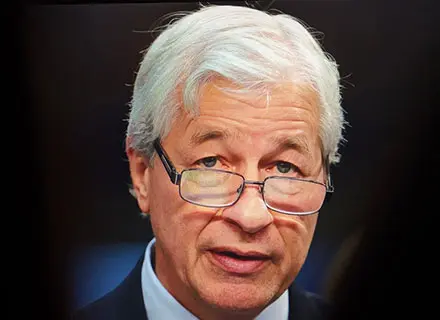

Wall Street traders have a half-joking line about JPMorgan Chase. The bank does not just report earnings, they say, it reports Jamie Dimon’s mood. It is an exaggeration. But not by much.
Few chief executives anywhere have become so bound up with the company they run that markets have coined a phrase for the value they personally add to the stock price.
That phrase is the “Jamie Premium.” And this summer, it is being put to its biggest test yet, as JPMorgan edges towards becoming the first bank in history to touch a USD 1 trillion market valuation.
The bank’s roots go back to 1799. Understanding how it got here means understanding the man who has run it for the last twenty years.
Who Is Jamie Dimon
James “Jamie” Dimon was born in New York City in 1956, the son of a stockbroker at American Express. He has said he picked up the language of markets at the family dinner table long before he ever set foot on a trading floor.
After Tufts University and an MBA from Harvard Business School, he joined Sandy Weill, the dealmaker who spent the 1980s and 90s stitching together what would eventually become Citigroup. Dimon was Weill’s right hand through most of it.
Then it fell apart. Weill fired Dimon in 1998, ending a 15-year working relationship that had, until that point, looked unshakeable. Dimon later said the episode hit his net worth harder than his self-worth, which is a tidy line for a man who spent the next 18 months weighing his options, including a serious conversation with Jeff Bezos about joining Amazon.
He chose banking instead. In March 2000, he took over as CEO of Bank One, a troubled Chicago lender that one analyst at the time said even Hercules couldn’t fix. Dimon put USD 60 million of his own money into the stock on his first day, cut costs, tightened up risk controls, and turned a bank that had posted a USD 511 million loss into one earning USD 3.5 billion within three years.
That turnaround caught JPMorgan’s attention. The two banks merged in 2004, and by the end of 2005, Dimon was CEO of the combined JPMorgan Chase. He took the chairman’s title a year later and has not left either post since, making him the longest-serving chief executive among America’s biggest banks by a considerable distance.
The Moves That Built an Empire
Dimon’s reputation was not built in the good years. It was built in 2008. While most of Wall Street was either drowning or being bailed out, JPMorgan went shopping.
In March that year, as Bear Stearns teetered on collapse, JPMorgan agreed to buy the storied investment bank for close to USD 1.4 billion, a fire-sale price backed by emergency Federal Reserve financing.
Six months later, Washington Mutual failed, still the largest bank collapse in US history, and JPMorgan bought its banking operations for roughly USD 1.9 billion.
Neither deal was clean. Both came loaded with legal exposure and legacy mortgage problems that JPMorgan spent years, and billions of dollars, untangling with regulators afterwards.
Dimon himself later grumbled that the two acquisitions became a convenient scapegoat for legal headaches the bank had inherited rather than caused. Still, the strategic logic held up. Lehman Brothers was gone.
Merrill Lynch had been sold in a rushed weekend deal. Wachovia had failed. JPMorgan, in the space of a single terrible year, had added a top-tier investment bank and a huge consumer deposit base while nearly everyone else on the street was shrinking.
The bank’s next real stress test came in 2012, when a botched derivatives trade out of its London office, the so-called “London Whale,” cost more than USD 6 billion and briefly dented Dimon’s reputation for having risk under control. He didn’t dress it up.
“The London Whale was the stupidest and most embarrassing situation I have ever been a part of,” he wrote in his 2013 shareholder letter, a rare moment of a Wall Street chief executive owning a failure in plain language rather than corporate hedging.
He testified before Congress, rebuilt the risk function, and moved on. It remains the closest JPMorgan has come to a genuine credibility crisis on his watch, which says something, given how long that watch has now run.
What followed was less dramatic but arguably more important. Dimon built what the bank now calls its “fortress balance sheet,” a deliberately conservative capital cushion meant to absorb shocks that would sink less careful rivals. He had been saying as much for years.
“It’s hard to predict when a storm will happen, but one thing is inevitable, it will happen,” he wrote in a shareholder letter back in 2002, long before most of Wall Street took the warning seriously.
That philosophy was tested again in March 2023, when Silicon Valley Bank and First Republic Bank both collapsed within weeks of each other. Dimon personally led efforts to organise a rescue for First Republic.
When that rescue failed, JPMorgan bought the bank’s assets and deposits outright, adding yet another chunk of the US consumer banking market to its own.
He also pushed the bank hard into technology, spending billions annually on digital banking, cybersecurity, and artificial intelligence, and built out its investment banking and trading arms so JPMorgan could compete seriously on both Wall Street dealmaking and Main Street lending at once, a combination few of its rivals can match at the same scale.
Record Numbers, Record Milestone
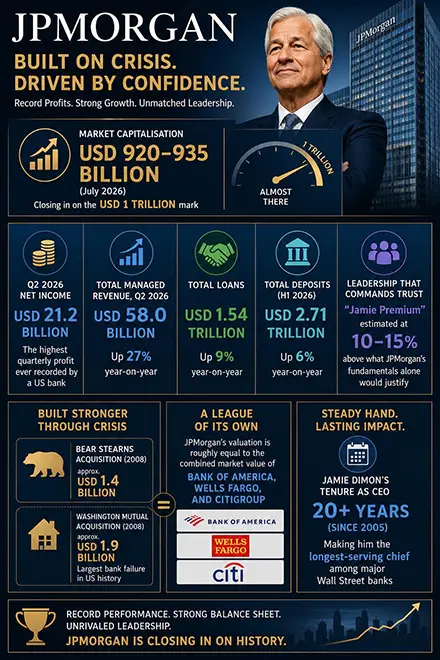 All of that is what has JPMorgan sitting at the edge of a historic number right now. In the second quarter of 2026, the bank posted net income of USD 21.2 billion, the highest quarterly profit any American bank has ever reported.
Total managed revenue climbed 27% year-on-year to USD 58 billion, helped by a surge in trading revenue, a rebound in investment banking fees, and a large one-time gain on the bank’s Visa stake. Strip that gain out and adjusted profit was still USD 16.9 billion, with a return on tangible common equity of 23%.
Loans grew 9% to USD 1.54 trillion. Deposits rose to USD 2.71 trillion. Credit quality, meanwhile, actually improved slightly, with card loss rates ticking down year-on-year, which suggests the growth isn’t coming from looser lending standards.
Put it together and JPMorgan’s market capitalisation sat at roughly USD 920 to 935 billion in mid-July 2026, within touching distance of USD 1 trillion. No bank has ever crossed that line. Getting there would put JPMorgan in a club currently occupied almost entirely by technology giants like Tesla, Meta, and Broadcom.
For context, JPMorgan’s current valuation is roughly equal to the combined market value of Bank of America, Wells Fargo, and Citigroup, three of its biggest domestic rivals, added together.
Explaining the “Jamie Premium”
Which brings us back to the Jamie Premium. It isn’t an official financial metric. You won’t find it in a filing. It’s a term analysts and investors use to describe the extra value the market attaches to JPMorgan simply because Dimon is the one running it, over and above what the bank’s underlying numbers alone would justify.
Investors and analysts have pegged that premium at somewhere between 10% and 15% of the stock’s value, a real sum given the size of the company.
The idea makes sense once you break it down. Buying JPMorgan stock isn’t just a bet on the bank’s assets and earnings. It’s also a bet on the judgement of the person deciding where that capital goes and how much risk to take with it, particularly through the next crisis nobody can yet see coming.
Dimon has now steered the bank through the 2008 crash, the European debt scare, a pandemic, the 2023 regional banking wobble, and a string of geopolitical shocks, without a single full-year loss along the way.
That record shows up in how the market prices the stock. When Dimon told an investor conference the shares were “very valuable,” traders piled in within hours, sending JPMorgan’s stock sharply higher.
There’s a catch, though. A premium built around one man is also a risk concentrated in one man. Dimon has spoken openly about succession, and the board has already said it plans to eventually split the chairman and CEO roles once he steps back.
Most analysts expect at least part of the Jamie Premium to fade whenever that handover happens, no matter how capable the next person turns out to be. Two decades of proven judgement isn’t something a successor can simply inherit on day one.
That day hasn’t come yet. For now, JPMorgan is standing at the edge of a milestone no bank has ever reached, carrying both the payoff of twenty years of disciplined, occasionally opportunistic leadership and the pressure of having almost no margin left for a mistake.