
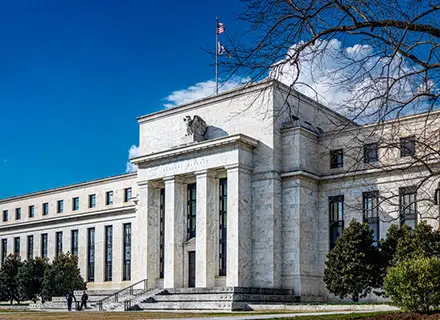

The Federal Reserve has raised interest rates and hinted at more hikes in the coming months, which appears to be a major setback for Donald Trump ahead of the November midterms.
The unanimous decision taken by the apex bank, under its new chief Kevin Warsh, has effectively put a stamp of acknowledgement on the Trump administration’s inability so far to control inflation.
While Trump, during his presidential campaign two years back, had promised to lower prices on his watch, the combined impact of his global import tariffs, an energy shock following the Iran war, and capital spending from the AI boom has kept price pressures intense enough.
Additionally, Trump’s ongoing trade war with Canada, which has cast serious doubt on the future of the USMCA (North America’s trade glue), along with the passage of the new bipartisan bill granting him further powers to impose 100% secondary tariffs on China and India—two of Russia’s largest energy producers—will likely keep the Fed vigilant.
The benchmark overnight interest rate, which was raised by a quarter of a percentage point to the 3.75%-4.00% range, may go up further, given the updated quarterly economic projections that show 16 out of 18 apex bank policymakers anticipating at least one more quarter-percentage-point hike by the 2026 end.
All but one indicated they saw upside risks to inflation that they now attributed to more than just one-off supply shocks.
Warsh, who again did not submit rate or other economic projections to the media, attributed the need for tighter monetary policy in part to an economy he sees as picking up speed.
For the new Fed boss, strong economic and job growth are adding to price pressures that no longer seem rooted in oil costs or import tariffs alone.
“There’s been a pretty wide-ranging set of data, including the labour market, indicating that the economy has strengthened. Domestic spending has been resilient, productivity growth strong, and capital investment is robust,” Warsh told reporters in listing the reasons that prompted him and the wider Fed policymaking panel to support a rate hike after advocating that rates should remain on hold at the Fed’s July 28-29 meeting.
Ironically, the rate increase became the first such move in three years and the first policy shift under the new Fed chief, who took office in late May after being selected by Trump with an expectation that he would cut rates.
“Inflation remains elevated. Today’s policy action will support a timelier return to the committee’s 2% goal,” the central bank’s Federal Open Market Committee said in its policy statement, after the end of a two-day meeting.
Warsh, speaking at his post-meeting press conference, called the rate hike the “right decision”.
“I would be hard-pressed to describe broad financial conditions as restrictive. This view was widely shared by the committee, so we removed a dose of accommodation,” he added further.
However, Warsh’s statement managed to displease Trump, who reacted quickly, repeating what has been a standing call since returning to office in January 2025 that interest rates in the world’s largest economy should be slashed to perhaps 1%, a level usually associated with Fed efforts to boost the economy out of a crisis, especially during inflation times.
“Interest Rates in the United States should be 1%, or less, because we are the Best Credit in the World — BY FAR. Our Country is BOOMING with new Investment! If we stopped Trading with every country that we have a Deficit with, which is most of them, we would make, at least, 1.5 Trillion Dollars a year. The word ‘Deficit’ is nothing more than a fancy word for LOSS … LOWER THE INTEREST RATES FOR THE UNITED STATES OF AMERICA, AND FAST!” Trump said on his Truth Social platform.
Trump clashed with former Fed Chair Jerome Powell, an episode that saw the Republican launching routine verbal attacks at the celebrated banking figure, who served during Trump’s first presidency and the reign of Democrat Joe Biden.
The clash ended up with Warsh replacing Powell.
Warsh, known for his style of conducting truncated press conferences, is currently focusing on the emerging evidence that has convinced him inflation would not improve at an adequate pace without tighter monetary policy, a direct counter to Trump administration officials’ comments that inflation was no longer a problem or would fall on its own over time.
The dollar strengthened broadly, and yields on two-year U.S. Treasury notes, highly influenced by Fed policy rate expectations, shot to the highest in more than two years after the release of the Fed’s policy statement and projections, which showed the policy rate rising to the 4.00%-4.25% range by the end of this year and ending 2027 at the same level.
According to CME Group’s FedWatch, the current direction of the rate futures markets reflects about a 90% probability of a follow-up quarter-percentage-point Fed rate hike by the end of this year.
The midterm elections will be crucial in terms of determining whether Republicans maintain control of the US Congress for the final two years of Trump 2.0.
As per the various surveys and projections, voters are already angry about high gasoline prices and interest rates on home mortgages, with the latter rising steadily this year.
The average rate on a 30-year fixed-rate mortgage is approaching 7%.
Fed policymakers marked up their estimates of inflation, as measured by the Personal Consumption Expenditures Price Index, to 3.7% versus the 3.6% projected at the June meeting.
As per their estimates, inflation is not projected to return to the 2% target until 2029, a year in which Uncle Sam will go into the presidential election.
Economic growth was marked up slightly from 2.2% to 2.3%, while the unemployment rate is seen ending the year at 4.1%, versus the 4.3% projected in June.