
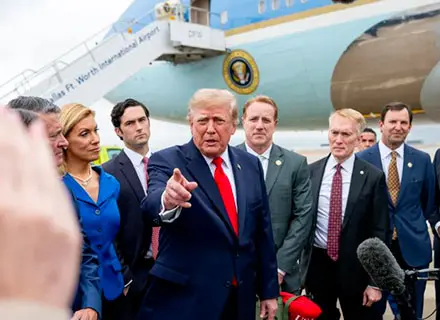

On September 17, Federal Reserve chief Kevin Warsh, the political appointee of Donald Trump, appeared in front of the American media with news that the White House would not have liked to hear: an increase in the benchmark overnight interest rate to the 3.75%-4.00% range.
Trump, during his presidential campaign two years back, had promised to lower prices on his watch. However, the combined impact of his global tariffs, an energy shock following the Iran war, and capital spending from the AI boom has kept price pressures intense enough.
Warsh, who called the rate hike a “right decision,” spoke in favour of a tighter monetary policy for an economy he sees as picking up speed.
For the new Fed boss, strong economic and job growth are adding to price pressures that no longer seem rooted in oil costs or import tariffs alone.
Troubled Trump didn’t like Warsh’s decision
Ironically, the rate increase became the first such move in three years and the first policy shift under the new Fed chief, who took office in late May after being selected by Trump with an expectation that he would cut rates.
An angry Trump reacted by repeating what has been a standing call since returning to office in January 2025 that interest rates in the world’s largest economy should be slashed to perhaps 1%, a level usually associated with Fed efforts to boost the economy out of a crisis, especially during inflation times.
Trump clashed with former Fed Chair Jerome Powell, an episode that saw the Republican launching routine verbal attacks at the celebrated banking figure, who served during Trump 1.0 and the reign of Democrat Joe Biden. The clash ended up with Warsh replacing Powell.
And it looks like Warsh is following Powell’s footsteps by maintaining the stance that inflation would not improve at an adequate pace without tighter monetary policy, a direct counter to Trump administration officials’ comments that inflation was no longer a problem or would fall on its own over time.
The timing of the Fed rate hike couldn’t have been worse for Trump 2.0, as it will face the politically crucial midterm elections, a phenomenon that will determine whether Republicans maintain control of the US Congress until the presidential elections of 2029.
As per the various surveys and projections, voters are already angry about high gasoline prices and interest rates on home mortgages.
While Fed policymakers, in their latest meeting, marked up their inflation estimates, guided by the Personal Consumption Expenditures Price Index, to 3.7% versus the 3.6% projected at the June meeting, they don’t see inflation returning to the 2% target until 2029.
Talking about the Iran war, the US Congress’ Budget Office Accounting, a nonpartisan bookkeeper, came up with a damning report on September 15, in which it gave the figure of USD 38 billion as the cost paid by Uncle Sam so far in the conflict happening in the Middle East.
The office estimates that the amount will rise by USD 3 billion each month. The war is anticipated to raise the ratio by 0.5% during the first three months of 2027 in terms of inflation.
Let’s focus on the energy price front, a critical barometer of any country’s economic machinery.
There are three factors that are dominating the price shock right now: disruption in the Strait of Hormuz, the strategically important narrow waterway through which roughly 20% of the world’s oil travelled before the war, occasional attacks on the energy facilities in Iran’s neighbouring Gulf countries and Ukrainian strikes on Russia’s refineries, that is hurting the diesel landscape.
As global inventories struggle to prevent their stockpiles from going down, the effect has been seen on the price front, with consumers feeling the pain all over the world.
In the United States, states have been forced to take steps to curb diesel and gasoline prices. According to data from the American Automobile Association (AAA), diesel hit a record of USD 6.53 a gallon around the last week of September.
The White House is reportedly considering regulatory relief that would allow broader sales of red-dyed diesel, a move that could allow some buyers to avoid the federal fuel tax.
Trump, speaking on the issue, said that he won’t mind backing a ban on diesel exports. Red-dyed diesel is generally reserved for off-road uses such as farming and is exempt from most federal fuel taxes.
The US Department of Energy will offer another 40 million barrels of crude from the Strategic Petroleum Reserve (SPR) in its bid to pull down the gasoline and diesel prices that have remained elevated nearly seven months into the Iran war.
The SPR ended August with 286.6 million barrels after another 3.1 million barrels left the reserve during the week ending August 28. That left the reserve well over 445 million barrels below maximum capacity.
Geopolitics hammering the US economy
The Congress Budget Office Accounting sees the rising cost of the Iran war potentially deteriorating the fiscal health of the world’s largest economy. The nation’s total public debt surpassed USD 40 trillion in August.
In the lead-up to the Iran war, the United States was witnessing a sort of recovery, with inflation standing at 2.4% in January, down from 2.7% in December 2025. Consumer buying power was also improving.
Then came the US-Israel joint strikes on Tehran, and nothing has been okay since then.
Trump said that the war would prove a “short-term excursion.” However, eight months on, no solution is in place. According to a segment of the American media, Trump is aiming for a significant peace deal in November, just days before the midterms, to gain political advantages.
But here is the brute reality: the economy will determine if Republicans keep control of Congress.
As per the Census Bureau’s September data, the US poverty rate edged down to the lowest on record in 2025, while median household income hit a record high.
As per the department, the decline marked the second consecutive annual drop in the poverty rate and brought it to its lowest level since the bureau began tracking the measure.
And here comes the most important figure: The poverty rate—the percentage of people living in poverty—dipped 0.5 percentage points to 10.2% last year.
Trump and Republicans will most probably use the data to present their side of the economy debate, but here is the comical tragedy: The same president, who, during his campaign, promised to “Make America Great Again,” and managed to do it to some extent on the poverty front, undid things himself by plunging into a geopolitical conflict.
The conflict has resulted in fuel price shock, inflation, and rising borrowing costs and mortgage rates.
In March, 35% of respondents to an NBC News poll said Trump had helped the economy. That number had dropped to only 26% by September.
Where things stand now
The August inflation numbers are out, and the increase was slower than expected. Price pressures, on the other hand, were more moderate in the prior month than previously reported, likely reducing the urgency for the Federal Reserve to raise interest rates again in October.
The Personal Consumption Expenditures Price Index (PCE) rose 0.3% after a downwardly revised 0.1% gain in July. Along with that, a sharp 4.4% rise in gasoline prices has kept inflation in the higher territory.
In the 12 months through August, PCE inflation advanced 3.4% after increasing by a downwardly revised 3.4% in July.
As per New York Fed President John Williams, the odds of an October rate hike were less, with the senior official seeing “no urgency” for further action.
A survey from the Conference Board showed consumer confidence plummeting to a near 12-1/2-year low in September, due to higher inflation and borrowing costs.
However, the same consumer spending, which accounts for more than two-thirds of the US’ economic activity, surged 0.9% in August.
Annual revisions to the BEA (Bureau of Economic Analysis) data showed households having more savings than previously estimated as well as a higher income profile, explaining the resilience in consumer spending.
But here is another data point that undoes the gain: a modest 0.2% income rise in August. Disposable income was flat after adjusting for inflation. The saving rate dropped to 4.1%, the lowest level since November 2022, from 4.6% in July.
“We remain cautious that as real labour incomes slow with higher gas prices, there remain headwinds to spending in coming months,” said Veronica Clark, an economist at Citigroup, while interacting with Reuters.
Even if the apex monetary body, in its October 27-28 meeting, decides to keep its benchmark interest rate unchanged, that would serve no purpose for Trump, as the ratio will be at the current 3.75%-4.00% range.
Sifting through the numbers
On September 30, the Commerce Department’s Bureau of Economic Analysis published its third estimate of Q2 GDP, as per which Uncle Sam grew at a “solid clip,” driven by robust consumer spending and business investment related to the buildout of AI infrastructure.
Q2 GDP increased at a 2.2% annualised rate, revised up from the previously estimated 1.5% pace. In the previous quarter, the economy grew at a 2.5% rate.
When BEA analyzed the data, it came out with the conclusion: The economy has so far been able to hold up in the face of the disruptions caused by the Iran war, especially on the energy front, as businesses have been aggressively investing in AI. Furthermore, generous tax refunds from 2025’s tax legislation were underpinning consumer spending as well.
Consumer spending, which accounts for more than two-thirds of the American economy, grew at a 3.8% rate last quarter, revised up from the previously reported 3.4% pace.
Even as consumers continue to spend, household budgets have increasingly come under strain as well because of higher inflation and gasoline prices.
Talking about the Conference Board survey, it noted households expecting a deterioration in business and labour market conditions over the next six months amid the Iran war and rising interest rates.
The Conference Board’s consumer confidence index plummeted 6.7 points in September to 81.9, the lowest level since April 2014, blurring divides like political affiliation, age, and income groups.
Dana Peterson, the Conference Board’s chief economist, noted that consumers’ write-in responses on the economy were mostly pessimistic, adding that “references to prices, the high cost of goods and services, and oil and gas prices in particular, rose to new heights.”
The share of consumers saying jobs were “plentiful” dropped to 23.6%, the lowest level since February 2021, from 24.5% in August.
The proportion who viewed jobs as “hard to get” climbed to 21.9%, the highest reading since January 2021, from 20.3% in August.
As per the Conference Board, the survey’s so-called “labour market differential” narrowed to 1.7% from 4.2% in August.
The economic think tank views the narrowing as a sign that the jobless rate may rise in the coming months, although the extent of this increase could be limited by a declining labour force due to an immigration crackdown and retirements.
A low-hire, low-fire job market
By the last day of August, job openings, a measure of labor demand in the world’s largest economy, had dropped by 256,000 to 7.079 million.
As per the Labor Department’s Bureau of Labor Statistics’ “Job Openings and Labor Turnover Survey,” or JOLTS report, data for July was revised higher to show 7.335 million vacancies instead of the previously reported 7.271 million.
While most of the economists view the labour market regaining its footing after struggling through much of the summer, the Labour Department is calling the current phase a “low hire, low fire” one.
Nonfarm payrolls increased by 162,000 jobs in August, the most in five months.
Hiring rose 46,000 to 5.192 million, with the ratio increasing to 3.3% from July’s 3.2%.
Layoffs and discharges, on the other hand, dropped by 61,000 to 1.641 million, with the rate dipping to 1.0% from 1.1% in July.
It only shows one trend: the labour market may be stable. However, employers are reluctant to ramp up hiring, and economists and analysts see geopolitical uncertainty playing a big role behind the trend, as elevated energy prices and inflation are already hammering the financials of businesses.
While the ratio of people leaving their jobs has remained in the lower territory, keeping wage inflation under control, it won’t stop further rate hikes.
Going inside Fed’s mind
“If people believe the Fed is actively addressing inflation, it tends to influence their expectations regarding price-setting behaviours. Flip side, if they don’t think we’re on the case, I think it flows through to price-setting behaviours,” Richmond Fed President Thomas Barkin said last month, while drawing a parallel with the decision dilemma often seen among companies: raising prices while preserving market share.
“You could reduce inflation physically: less demand, more supply, and prices come down. You could reduce inflation based on expectations,” he stated further.
“Whether inflation stems from supply shocks or classic overheated growth, the only way the central bank can close the gap is by reducing demand—and, with it, output and employment,” Chicago Fed President Austan Goolsbee remarked.
The labour market, as per the Fed, is currently “balanced near full employment,” with the jobless rate of 4.1% and moderate wage gains considered consistent with 2% inflation.
Inflation, as measured by the Personal Consumption Expenditures Price Index, is high enough at 3.7% to concern central bank officials, but not near the post-pandemic levels that prompted the stiffest Fed rate hikes since the 1980s.
“Right now, the labour market is not a source of inflation. There’s not necessarily a need to slow the labour market down or to cool it to attain our inflation target. … It comes by changing the expectations of folks that are thinking they need to raise prices by 3 or 4%,” St. Louis Fed President Alberto Musalem told Reuters.
“There doesn’t necessarily have to be a Phillips curve trade-off,” he added further, while giving a reference to the phenomenon of inflation and unemployment moving in opposite directions.
The Phillips curve trade-off describes an inverse relationship between inflation and unemployment, meaning lower unemployment tends to cause higher inflation, and higher unemployment tends to cause lower inflation.
When inflation soared to a 40-year high after the pandemic, prominent economists relied on the same theory to estimate that the unemployment rate would perhaps need to hit double-digits for prices to ease.
Businesses responded to the Fed’s outlook by slashing high levels of job openings.
Global supply chains recovered from the pandemic-led disruptions, and consumers steadied their spending, which in turn eased the fast-rising prices.
And the result arrived immediately, with both inflation and the unemployment rate plummeting in defiance of models based on the classic trade-off between ample jobs and tame price increases.
However, the 2026 situation is a different one, as the businesses have already factored in slower progress and a longer inflation fight.
In its September 16 policy statement announcing the first rate hike in three years, the Fed said the increase would “support a timelier return” to the 2% target—though not necessarily a timely one.
Accompanying projections then showed officials envisioning PCE inflation remaining above 2% until 2029.
The market sees three more quarter-percentage-point increases over the Fed’s next five meetings through April 2027.
Will the interest rate go down? The answer is no
In September, US employers added just 29,000 jobs. August payroll gains got revised downward. The unemployment rate ticked up to 4.2%, from 4.1%.
“You don’t have this magic bullet that, ‘Oh, we’re going to raise rates and it’s going to hit just AI,’ right? And AI is going to then slow, and that’s going to take this demand pressure off,” said Tim Duy, chief US economist at SGH Macro Advisors.
“I think it’s going to be very hard to slow inflation without inflicting some collateral damage on the economy, on the labour market,” he said.
So, what will happen in the October meeting of the Fed? Maybe a rate hike pause, but definitely not a slashing.
Trump will have to wait for the much-needed arrival of a lower interest rate regime, and meanwhile, he has no other option but to face the angry voters in the upcoming midterms.
After all, headwinds on the energy and inflation front have been brought on by the Iran war, a phenomenon that started with the joint US-Israeli air strikes in the last week of February.
And guess who gave the final approval of that campaign? Trump himself.
Image Courtesy: White House