

Almost a third of SpaceX’s tradable stock has been sold short six weeks after listing, handing the bears USD 15.5 billion. The August lock-up will decide whether they keep it
By the close on July 22, investors betting against SpaceX were sitting on USD 15.5 billion of paper profit. The company had been publicly traded for six weeks.
Nothing about the listing pointed that way. SpaceX priced 555.6 million shares at USD 135 on June 11 and raised USD 75 billion, rising to USD 85.7 billion once underwriters took up their overallotment. It was the largest flotation ever completed anywhere, more than double the USD 29.4 billion Saudi Aramco raised in 2019.
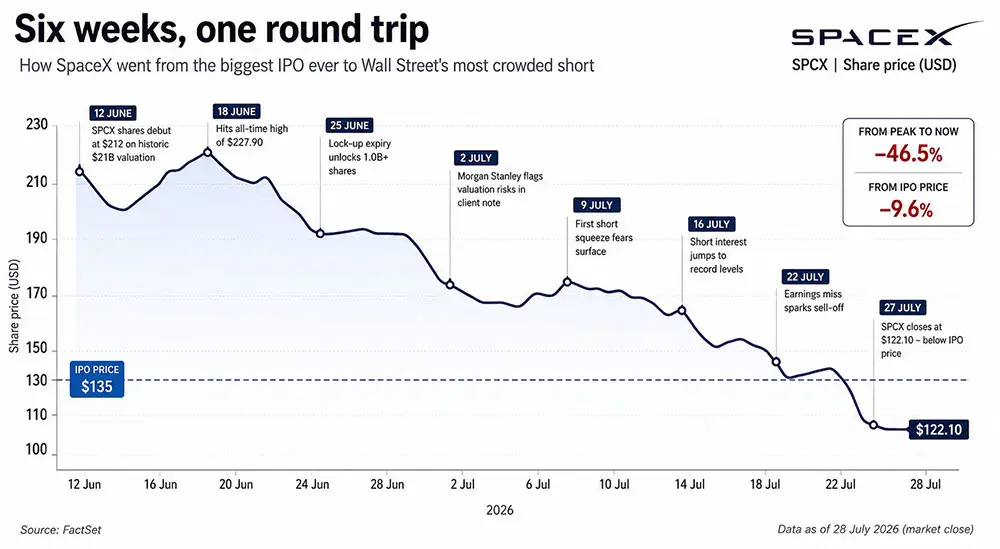
The stock opened at USD 150 the next morning and closed its first session 19% above the offer price. Four days later it touched USD 225.64 intraday, valuing the rockets-to-AI conglomerate at roughly USD 2.1 trillion and making Musk the world’s first trillionaire.
The turn
The reversal since has been close to total. SpaceX closed at USD 113.50 on Monday (July 27), a record low, before recovering to USD 116.41 the following session. That leaves it around 48% below the June peak and some 14% under the price at which shares were sold to the public.
Retail investors who took allocations at USD 135 are under water, and anyone who bought at the top has lost close to half their money. SpaceX and Tesla together have shed USD 1.2 trillion of market value in July alone.
The timing of that record low is the part the bulls should find uncomfortable. It came days after Starship Flight 13, a near-flawless test and the clearest operational win the company has had since listing. The stock fell anyway.
Short sellers, meanwhile, have been adding rather than banking. Bloomberg put their paper gains at USD 3.88 billion on July 15. Ortex Technologies had it at USD 8.7 billion the following day, when the stock first traded through its offer price, and at USD 15.5 billion by July 22. Almost USD 12 billion arrived inside five sessions.
Reading the position data
The build-up has been fast. Short interest sat at roughly 40 million shares at listing, between 5% and 7% of tradable stock and unremarkable for a hot debut. By end-June it was near 83 million. S3 Partners now counts more than 206 million shares short, about 32% of the float and roughly USD 25 billion of notional exposure.
Ortex reads it slightly lower at close to 196 million, and adds that around 49% of the free float is out on loan. Peter Hillerberg, who co-founded Ortex, called the speed of it unusual for a stock less than a month old.
Anyone quoting those numbers should know where they come from. FINRA’s settlement data, the official record, showed roughly 110 million shares short at the end of June, close to half the vendor estimates. The gap reflects method rather than error.
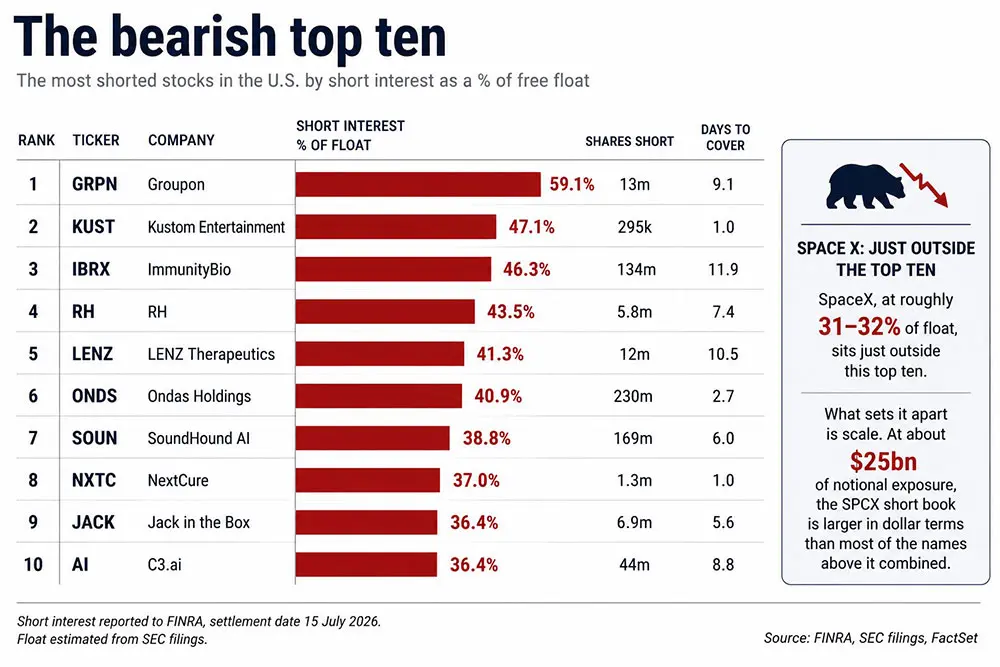
The official figures appear twice monthly and with a lag, while Ortex and S3 model stock-lending flows nearer to real time. It also means SpaceX does not show up on the standard most-shorted screens, which rank on FINRA data. Groupon leads that table at 59.1% of float, ahead of ImmunityBio and RH.
Measured in dollars rather than percentages the comparison is not close. At roughly USD 25 billion of notional exposure, the SpaceX short book is worth more than most of that list combined, and has been widely called the most heavily shorted newly listed stock Wall Street has tracked.
Why the float made it possible
Most of what has happened traces back to one decision about supply.
SpaceX released fewer than 5% of its shares into public hands at listing. A company carrying a USD 2 trillion valuation was trading on a base of a few hundred million shares, and into that thin base came buyers with no discretion.
FTSE Russell added the stock to its US indices in late June, and Nasdaq moved it into the Nasdaq-100 on July 7 under revised rules for new listings. Every tracker fund and ETF benchmarked to those indices had to buy, whatever the price.
That is a good environment to sell into. It is a much worse one to own, because the price it produces is not really a price. It is a queue.
What followed was the more considered part of the trade. Rather than a single cliff-edge expiry, SpaceX adopted a staggered unlock in tranches of roughly 7% at days 70, 90, 105, 120 and 135 after listing.
The first meaningful wave lands two trading days after the maiden earnings report, releasing up to 911.5 million shares unconditionally on 6 August.
A further 455.8 million, worth about USD 62 billion, unlock only if the stock closes at or above USD 175.50 on five of the ten sessions before results. Near USD 116 that is effectively dead, which points to the smaller tranche being the one in play.
For a short seller this is close to ideal. The supply event is dated, the size is disclosed and the arithmetic is public.
The balance sheet the prospectus only hinted at
Two disclosures in the fortnight after listing did the rest of the damage, both concerning commitments the company had already made.
On June 22, ten days after the debut, SpaceX launched its first bond sale, pricing USD 25 billion across five tranches maturing between 2031 and 2056. The paper is investment grade at Moody’s, Fitch and S&P, and the proceeds repay in full the bridge loan used to buy xAI in February.
That bridge had a hard maturity of September 2027, so the refinancing was always coming. The shares fell 16% regardless. What unsettled the market was not fresh borrowing so much as confirmation that SpaceX had entered public life carrying debt the equity story had glossed over.
Four trading days after listing the company had also exercised its option to acquire Cursor for USD 60 billion, entirely in stock, diluting holders by around 3.4% and signalling that newly minted equity would be spent as acquisition currency straight away. The deal should close in the third quarter.
Against that, a Starship launch abort in mid-July that took roughly USD 100 billion off the market value looks almost incidental. Borrowing the stock has cost about 1.95% throughout, cheap enough that none of these views had to be right quickly.
The other side
None of which makes the position comfortable.
A stock with 32% of its float short on vendor numbers, and half that float lent out, is crowded, and crowding is its own risk. Ortex calculates that every one-dollar move shifts the value of outstanding short positions by more than USD 300 million.
Should sentiment turn, the bears must buy back stock they do not own, out of a float that is small for the same reason it was easy to attack. Hillerberg has described the position as a considerable amount of fuel if it tips into a squeeze.
The bull case has not gone quiet. Morgan Stanley’s Adam Jonas has reiterated a buy with a USD 300 target. Consensus across 31 analysts surveyed by TipRanks sits at USD 235.18, far above the market but drifting lower all month, so read it as a direction rather than a destination.
Cathie Wood’s ARK funds have put close to USD 115 million into the stock in July alone. Musk posted on microblogging platform X (formerly Twitter) that the survival probability of firms holding significant short positions in SpaceX is very low, a remark that costs nothing to make and has occasionally proved expensive to ignore.
August
SpaceX reports quarterly results as a public company for the first time after the US close on August 4. Two days later, up to 911.5 million shares come free.
Those results will be the first look at how the three businesses inside the company perform against one another. SpaceX reports across Space, Connectivity and AI, the last arriving with xAI and covering Grok, X and the compute behind them.
Analysts have modelled Starlink economics and frontier-model spending from the outside, with no segment history to work from. Both the valuation argument and the debt argument rest on figures nobody has seen.
Six weeks in, the bears have been right about the valuation and right about the timing, which is a rarer combination than it sounds. What they have not yet had is a day when the news went the other way and the market cared.