
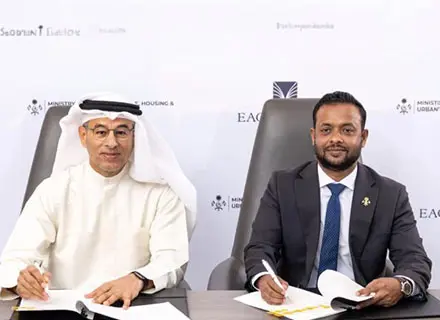

Abu Dhabi-based developer Eagle Hills has signed a commercial terms agreement with the Maldives government for a proposed USD 12 billion waterfront and marina destination in Ras Male, marking a major expansion of the Gulf developer’s international real estate ambitions and the island nation’s push to attract foreign capital.
The Maldives Waterfront and Marina is planned as an integrated island destination combining international hotels and resorts, premium and branded residences, a marina, waterfront promenades, restaurants, retail, entertainment, and wellness facilities. The agreement announced on Monday also includes plans for education, healthcare, and community infrastructure.
The development will be built on reclaimed land in the Ras Male area, part of the Maldives’ broader effort to create new urban and economic space around the densely populated capital, Male. Properties will be offered under a long-term leasehold framework governed by Maldivian law, with terms of up to 99 years. A new lease term of up to 99 years will begin when a property is transferred through sale or inheritance.
The USD 12 billion figure represents the overall development scale envisaged across various phases, rather than an upfront capital commitment by Eagle Hills. The agreement covers the principal commercial terms, while detailed terms are still to be worked out. The parties have not disclosed a construction timetable, detailed phasing, or the financing structure.
That distinction is important as the project moves from agreement to execution. A separate report by The National put the development’s longer-term investment ambition at about USD 20 billion, while noting that the amount represents investment envisaged across phases rather than a disclosed upfront commitment. The differing figures underline that the project remains at an early development stage and that its ultimate capital requirement is yet to be finalised.
The Maldivian government is positioning the project as a major new source of foreign investment and a potential second pillar alongside tourism. Infrastructure, Housing, and Urban Development Minister Abdulla Muththalib described it as the country’s largest investment programme and said it would bring billions of dollars in foreign investment through the banking system.
The government also said the state would receive direct revenue from property sales without tax giveaways or government borrowing. It has been described as a step towards establishing a structured real estate sector alongside the country’s established tourism industry.
Tourism remains central to the Maldivian economy, but the country has limited land and a highly concentrated urban footprint. Ras Male forms part of a large land-reclamation programme designed to create additional space for housing, commercial activities, and tourism. The wider masterplan envisages more than 1,100 hectares of reclaimed land and about 65,000 housing units, according to The National.
The Maldives’ dependence on its marine ecosystem will likely lead to close scrutiny of environmental considerations. Eagle Hills said the project would involve no further dredging by the developer and that independent marine monitoring would accompany construction. The master plan is also expected to incorporate resilient infrastructure and measures intended to protect the surrounding natural environment.
For Eagle Hills, the agreement extends a strategy centered on large-scale waterfront and mixed-use destinations. The Abu Dhabi-based company was founded by Mohamed Alabbar, who also founded Emaar Properties, the developer of Dubai landmarks including Burj Khalifa and Dubai Mall.
Eagle Hills has expanded its portfolio beyond the UAE, including the USD 2.5 billion Durres Yachts and Marina development in Albania. It is also involved in the Maryam Island waterfront development in Sharjah and has announced plans to oversee the redevelopment of Lulu Island in Abu Dhabi.
The Maldives deal comes amid increasing Gulf investment in the island nation’s property and infrastructure sectors. UAE-linked developers have pursued luxury resorts and residential projects, reflecting growing interest in the Maldives as a destination for high-end tourism and second-home investment.
The developer and government said the destination aims to expand the South Asian country’s tourism offerings by attracting visitors and encouraging them for longer stays and repeat visits. By combining hospitality with permanent residential, commercial, and community uses, the project is designed to generate economic activity beyond the traditional resort model and create a more diversified base for investment in the Maldives.
The project could therefore have implications beyond hospitality. Its combination of residential property, tourism, retail, marine services, and community infrastructure could create opportunities for construction companies, banks, professional services firms, and local suppliers.
However, one should not confuse the size of the headline investment with the money already committed or deployed. Financing arrangements, construction milestones, and Eagle Hills’ direct capital contribution remain undisclosed.
If those elements are subsequently agreed upon and delivered, the development would represent a significant new phase in the Maldives’ attempt to diversify its economy while extending the Gulf’s growing role in international real estate and tourism development.
Image Courtesy: Eagle Hills