

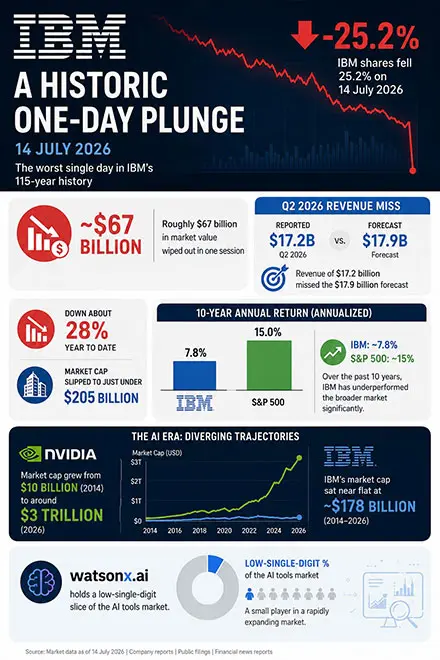
Shares in International Business Machines fell 25.2% in a single day, on 14 July 2026. That was the worst day in the company’s 115-year life, worse even than Black Monday in 1987, when the entire market collapsed.
In a few hours, roughly USD 67 billion of the company’s value simply vanished. To put that in plain terms, IBM lost more wealth in one afternoon than most large companies are worth in total.
The trigger looked small on paper. IBM warned that its April-to-June sales came in at USD 17.2 billion, about USD 700 million short of what Wall Street expected. A shortfall of that size does not usually erase tens of billions in value. So why did investors react as if the building were on fire?
The answer is that a share price does not reflect one bad quarter but what people believe about all the quarters still to come. And on that Tuesday, a lot of people quietly changed their minds about IBM’s future. The miss was the moment the symptoms became impossible to ignore.
Why the fall felt so shocking
 For most of the last century, IBM was not just a technology company. It was the technology company. There is a famous saying in corporate life that “nobody ever got fired for buying IBM.” It built the machines that ran banks, governments, airlines and insurers.
Its mainframe computers still quietly power a huge share of the world’s card payments and financial systems today. When a name carries that much history and trust, a crash of this scale feels almost unthinkable. Giants are not supposed to fall 25% in an afternoon.
There was a second reason for the shock. IBM had actually been having a decent run. Only weeks earlier, in June, the stock had touched an all-time high above USD 329. Its own management had promised strong growth in its most profitable business, software.
So when the warning landed, it did not just disappoint. It contradicted the story the company had been telling.
IBM’s chief executive, Arvind Krishna, admitted as much in a blunt letter to investors, writing that the company had faltered, had not moved quickly enough, and had watched several large deals slip away. When a boss says that out loud, markets listen.
Why it was also entirely predictable
Here is the uncomfortable truth. If you stopped staring at the recent share price and looked at the longer picture, this was not a bolt from the blue. It was a slow drift finally catching up with reality.
Consider the numbers over ten years. An investor who put money into IBM earned a little under 8% a year. The same money in a simple fund tracking the wider US market earned close to 15% a year. Over a decade, that gap is enormous. It means IBM was steadily losing the race long before anyone panicked.
The clearest illustration is the comparison with Nvidia, the chipmaker now at the centre of the AI boom. Back in 2014, IBM was worth roughly eighteen times more than Nvidia. Today the roles are almost perfectly reversed, with Nvidia worth many times more than IBM.
IBM’s value barely moved across those years while a former minnow became one of the most valuable companies on earth. That is the visual definition of an industry laggard. The world raced ahead. IBM largely stood still.
The warning signs were already flashing
This year alone had offered two clear rehearsals for July. In late February, the stock dropped more than 13% in a day, its worst session in a quarter of a century, after the AI firm Anthropic showed that its tools could modernise COBOL, the ageing programming language that runs on IBM mainframes.
That mattered because updating those old systems is exactly the kind of slow, expensive work IBM’s consultants are paid billions to do.
If a cheap AI tool can do it faster, one of IBM’s most profitable jobs is suddenly at risk. Then in April, IBM’s consulting arm barely grew while its automation software grew ten times faster, a quiet sign that customers increasingly want ready-made AI tools rather than armies of advisers.
In short, the very technology IBM was selling as its future was also eating into its present. Anyone paying attention had seen this film before. July was simply the loudest screening yet.
Falling behind in the race that mattered most
The most damaging place to fall behind was artificial intelligence, and this is where IBM’s story turns almost tragic. IBM was early to AI. In 2011 its Watson system beat human champions on the quiz show Jeopardy! and, for a moment, Watson was shorthand for machine intelligence itself. IBM had the lead, the brand and the attention.
Then it lost the thread. Watson never found a clear, money-making purpose and quietly faded. When the current wave of AI arrived, the momentum belonged to others.
Microsoft, Google and Amazon poured resources into cloud computing and AI at a scale IBM could not match, and those three now dominate the market where modern software lives. Newer names such as OpenAI became household words.
IBM rebuilt its offering under the name watsonx and made sensible, grown-up bets on trust, governance and helping big companies use AI safely. It even partnered with AI firms like Anthropic to strengthen its tools.
But in the fight for actual market share, watsonx remains a small player, holding only a low-single-digit slice of the AI tools market. Being sensible is not the same as being a leader.
The final irony
The specific reason for July’s crash captures IBM’s predicament perfectly. Krishna explained that customers had stopped spending on IBM’s software and services and were instead rushing to buy hardware, servers, storage and memory chips, to prepare for the AI wave.
Prices for those components have been climbing fast because AI data centres are consuming them in vast quantities.
Read that again slowly. IBM’s customers were spending heavily on the AI boom. They were just not spending it with IBM.
The gold rush was happening all around, and IBM was left selling shovels that fewer people wanted. Some analysts noted that this explanation might be a little convenient for management, since it points the finger at the wider industry rather than at IBM’s own execution.
Either way, the message was the same. When the biggest spending wave in a generation arrives and your revenue goes backwards, the problem is not the wave.
What it means
None of this makes IBM worthless. It still generates enormous amounts of cash, pays a dependable dividend it has raised for more than thirty years, and owns critical systems the world genuinely relies on.
For income-focused investors, there is a real case that the stock is now cheap. A securities investigation and shareholder lawsuits now hang over the company, and its full results on 22 July will be watched closely, but the business is not about to disappear.
The deeper lesson is about how decline actually works. It rarely arrives as a single dramatic event and often builds quietly, as one missed opportunity at a time, while the brand and the balance sheet keep everyone comfortable.
IBM’s crash felt sudden because the share price had been polite about the truth for years. The 25% drop was not the moment IBM fell behind. It was simply the moment the market finally admitted to that fact.