
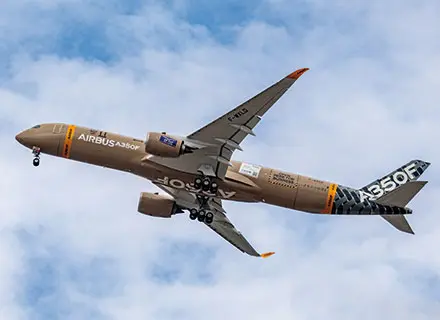

Airbus has taken a major step towards breaking Boeing’s long-standing dominance of the large-freighter market, flying its A350F cargo aircraft for the first time on Tuesday as it targets entry into service in 2027.
The windowless freighter, derived from Airbus’s A350 long-haul passenger family, took off from Toulouse, France, on a four-hour maiden flight. The aircraft will now begin an intensive certification campaign lasting about nine months, with Airbus targeting certification and first customer deliveries in 2027.
The first flight marks a significant milestone for Airbus, which has faced challenges in establishing a foothold in the large-freighter segment.
Boeing has dominated the market with aircraft including the 747 freighter, 767 freighter and 777F, while Airbus’s previous attempts to build a comparable presence have not matched the US manufacturer’s success.
“This maiden flight is a major milestone for the A350F and for our customers worldwide. As the latest development of our highly successful A350 platform, the A350F is a true game-changer for the air cargo market, combining unmatched operational flexibility, fuel efficiency, and range,” stated Lars Wagner, CEO Commercial Aircraft at Airbus.
“I am immensely proud of the extraordinary dedication and hard work of all the teams who have made this achievement possible,” he stated further.
The second A350F prototype (MSN 701) is now at an advanced stage of final assembly and will enter the paint shop in the next few weeks, the planemaker remarked.
The A350F is designed to change that equation. Airbus says it has already secured 115 orders for the aircraft from 14 customers, according to figures reported around the maiden flight.
That compares with 81 orders for Boeing’s forthcoming 777-8F, although Boeing’s aircraft remains part of the wider 777X programme and has yet to enter service.
Among Airbus’s customers is Atlas Air Worldwide, one of the world’s largest operators of outsourced airfreight capacity.
In March, Atlas placed a firm order for 20 A350Fs, making it the aircraft’s largest customer and its first in the US.
The decision is notable because Atlas has extensive experience operating Boeing widebody freighters.
Air China Cargo has also committed to the programme, increasing its order to 10 aircraft in May.
The carrier said the aircraft would complement its existing fleet of A330-200 passenger-to-freighter conversions and provide additional capacity on international long-haul routes.
The A350F is intended to compete on both economic and cargo capabilities. Airbus says the aircraft can carry up to 111 tonnes of payload and fly up to 8,700 kilometres.
More than 70% of its airframe is made from advanced materials, helping make it substantially lighter than competing aircraft, while its Rolls-Royce Trent XWB-97 engines are designed to deliver lower fuel consumption and emissions.
The aircraft also features what Airbus describes as the largest main-deck cargo door in the industry, with its fuselage dimensions optimised around standard pallets and containers.
The design is intended to make the aircraft suitable for the growing movement of high-value and time-sensitive goods, from pharmaceuticals and electronics to semiconductors and e-commerce shipments.
Fuel efficiency is likely to be a central battleground. Cargo airlines operate in a business where fuel represents a substantial component of operating expenses, making the economics of each tonne of freight particularly important.
Airbus says the A350F will offer up to a 20% reduction in fuel consumption and carbon emissions compared with previous-generation aircraft in a similar payload-range category.
“Powered by the latest Rolls-Royce Trent XWB-97 engines, the aircraft will bring a reduction in fuel consumption and carbon emissions of up to 40% compared to competitor aircraft with a similar payload-range capability. It is the first new freighter to fully meet the latest ICAO’s CO₂ emission standards,” Airbus noted.
Regulation is another factor working in favour of new-generation freighters. The aviation industry is facing tighter emissions requirements, increasing pressure on airlines and cargo operators to replace older aircraft or convert existing passenger jets rather than continue relying on ageing freighter fleets.
Boeing nevertheless remains a formidable competitor. The company has forecast demand for about 930 new production freighters and 2,000 passenger-to-freighter conversions over the next 20 years, reflecting its expectation that global air cargo will continue expanding.
The contest will therefore extend beyond the two manufacturers’ aircraft specifications. Boeing has decades of experience in the freighter market, an established customer base and a large global ecosystem supporting its cargo aircraft.
Airbus, meanwhile, is attempting to leverage the A350 platform’s established long-haul credentials and the operating efficiencies of a clean-sheet freighter.
The A350F itself is not simply a passenger aircraft stripped of seats. Airbus has developed a dedicated main-deck cargo loading system, a large cargo door, fire and smoke protection systems, a courier area, anti-tail-tipping technology and other systems specifically for freight operations.
Ground testing has included loading the aircraft to its maximum 111-tonne payload and testing the drainage system and cargo-door operation.
The certification campaign will use two test aircraft and is expected to involve about 400 flight hours.
The first aircraft will focus heavily on aerodynamic performance and handling, while the second will undertake testing of systems such as air conditioning and fire and smoke detection.
For Airbus, the maiden flight is therefore more than just a programme milestone. It is the opening move in a bid to reshape a market where Boeing has held a powerful position for decades.
The outcome will depend on whether Airbus can translate its A350 technology, growing order book and promised fuel savings into reliable deliveries and attractive economics for cargo operators.
For airlines and logistics companies planning fleet renewal, the emergence of a credible Airbus alternative also gives them another option as the global freighter fleet enters a period of technological and regulatory change.
Image Courtesy: Airbus