
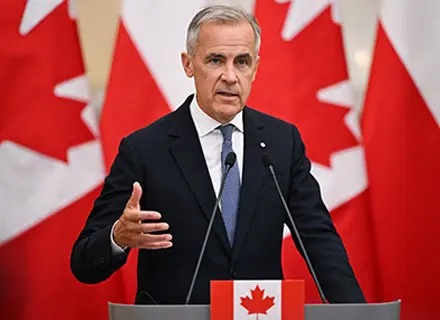

“Ottawa is increasingly prioritising trust-based partnerships with countries outside North America as it responds to a changing international order and growing economic uncertainty,” Anand told the Reuters, while speaking on the sidelines of a US-hosted meeting of foreign ministers from the Group of 20 (G20) major economies.
As per Anand, the Mark Carney administration is stressing upon having new approaches, alliances, partnerships and international groupings to address emerging geopolitical and economic challenges.
Carney himself has pledged to double the country’s trade with markets outside the US over the next 10 years.
The commitment comes as President Donald Trump’s tariffs continue to affect the Canadian economy.
While Ottawa has imposed counter-tariffs against American imports, it has also engaged with the Trump administration to secure a trade agreement.
However, progress in those discussions has been extremely slow.
Last weekend, the revival of the Keystone XL pipeline, a long-delayed infrastructure project designed to transport Canadian crude oil to US refineries, reportedly emerged as the central theme of the trade talks between Washington and Ottawa, with the Trump administration now claiming to have a preliminary concept for a “new deal” with Uncle Sam’s North American neighbour, signalling potential progress in negotiations with the Carney government.
Trump said he had another conversation with Carney on Saturday and that the proposed agreement would benefit American farmers and the broader US economy.
“I spoke to him again yesterday, and we have the concept of a deal that’s going to be great for our farmers, great for our country, and we’ll be fine for that,” Trump told reporters in Dubuque, Iowa.
The trade dispute has also become a political issue in several northern US border states, including Michigan and Maine, ahead of this week’s US midterm elections.
In fact, tariffs on Canadian imports have become a point of concern for Republican candidates in these key battleground states. They have already called for an end to the trade war.
Responding to the complaints, the US President, a week back, signed an order removing 50% tariffs on certain Canadian agricultural and forestry products, along with a few other imports, a move that could benefit businesses in states such as Maine.
Notwithstanding these positive developments, Ottawa will still accelerate negotiations and pursue partnerships across the Asia-Pacific region, Europe and the Middle East.
Canada’s diversification strategy extends beyond conventional trade agreements, with Ottawa seeking deeper cooperation in areas such as critical minerals, energy, food security, technology and defence.
Anand cited a national security strategy released earlier in the week, which places considerable emphasis on these sectors and the importance of strengthening international partnerships.
“Canada is actively engaging to ensure that, if necessary, new bodies, groupings, alliances, and partnerships are formed to address current crises,” she said.
According to Anand, Canada has already established 20 new security and trade agreements with countries and international partners around the world. These arrangements provide access to approximately 1.5 billion consumers across more than 51 countries.
Ottawa intends to continue expanding its international commercial relationships as it seeks to reduce its reliance on the American market.
Anand also said Canada was the only Group of Seven (G7) economy with free trade agreements covering every other G7 member.
The Carney government expects to conclude a similar trade agreement with the Association of Southeast Asian Nations (ASEAN) before the end of the year.
Canada’s long-term goal is clear: to strengthen its status as a middle power that can establish economic and security partnerships across various regions instead of depending heavily on a single trading relationship.
Europe has emerged as a particularly important part of Carney’s diversification strategy.
On Friday, the Canadian PM said he and his European counterparts would work over the coming months to determine the scale and scope of a proposed new form of European Union membership for Ottawa.
He said the country would become the bloc’s first “associate member”.
The proposal, initially suggested by European Commission President Ursula von der Leyen, has generated disagreements among EU member states.
The terminology proved sufficiently divisive that it was excluded from the final statement issued following the Canada-EU summit in Montreal.
Nevertheless, Carney described the initiative as an “alliance for the future”, focused on strengthening resilience across strategic industries, including AI, energy and critical minerals.
“We are working towards the deepest possible partnership, short of accession,” Carney said, adding that the arrangement would result in “Canada becoming the European Union’s first associate member.”
However, the proposed associate membership does not have an established legal meaning, and Germany and several other EU countries have opposed the terminology.
Earlier drafts of the summit’s final statement reportedly included at least two references to Canada becoming an associate member, although they did not explain what such a status would involve.
However, the joint statement released after the Friday’s summit instead emphasised Canada’s and the EU’s “unwavering commitment to effective multilateralism, democracy and to the rules-based international order”.
Canada’s EU pivot has, however, drawn Trump’s ire, with the Republican not only criticising multilateral institutions, apart from threatening to make Canada the 51st US state, but also challenging Carney’s attempts to deepen the relationship between Ottawa and Brussels, by warning of imposing trade sanctions in response to von der Leyen’s proposal for a new status governing EU-Canada relations.
Despite disagreements over the associate membership proposal, Canada and the EU have made progress on their commercial relationship.
The summit’s joint statement confirmed that negotiations on a digital trade agreement had been concluded. The proposed arrangement is expected to complement the existing trade agreement between Canada and the 27-member European Union.
Trade with the EU currently accounts for approximately 9% of Canada’s overall trade, according to government statistics.
Although Canada already has a trade agreement with the bloc, 10 EU member states have yet to ratify it.
The digital trade agreement could provide another avenue for strengthening commercial links, particularly as both sides seek greater resilience in strategic industries and supply chains.
Carney, on Friday, also said that he had accepted an invitation from the president of the European Council to attend meetings in Europe next June, when discussions on the proposed more profound relationship are expected to conclude.
The PM said the partnership would support the development of industries and infrastructure required to strengthen collective security.
“We are building the industries and infrastructure that underwrite our collective security,” Carney said. “This is only the beginning.”