
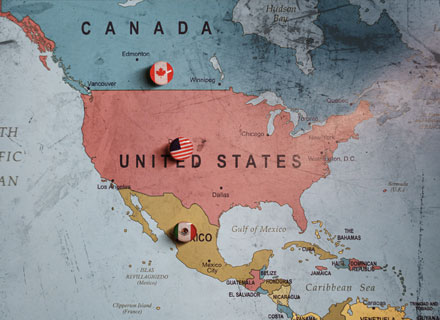

For more than 30 years, the United States, Mexico, and Canada have operated under a shared set of trade rules that turned three separate economies into something that functions almost like one.
Factories on both sides of every border pass parts back and forth. A car built in Michigan contains components machined in Ontario and wiring from Monterrey. The arrangement, now formalised under the United States-Mexico-Canada Agreement, underpins roughly $1.6 trillion in annual trade between the three countries. It has made North America one of the most tightly integrated manufacturing regions on Earth.
That arrangement is now under serious strain. The second Donald Trump administration has used its opening years to challenge the foundations of the deal, deploying tariffs, legal threats, and negotiating pressure to push both neighbours toward a version of the agreement that serves American interests far more narrowly.
Formal bilateral talks between the United States and Mexico began in Mexico City on May 28. Canada has been left out of those opening rounds entirely. On July 1, the agreement faces its first mandatory review, at which all three countries must decide by consensus whether to extend it for another 16 years.
The outcome of that review will shape the economic geography of North America for decades. To understand what is at stake, it helps to start at the beginning.
How the Integrated Economy Was Built
NAFTA, signed in 1993, was the agreement that first stitched the three economies together. Earlier, each country maintained its own tariffs and trade barriers, and manufacturers largely sourced components domestically, or from global suppliers.
NAFTA changed the incentive structure fundamentally. If you could produce something more cheaply across the border, it suddenly made sense to do so. Over the following decades, supply chains reorganised themselves around that logic.
By 2024, the total value of goods and services moving between the three countries had reached an estimated $1.93 trillion annually. Canada and Mexico are now the United States’ two largest trading partners, ahead of China. The depth of integration shows up in a striking statistic.
Nearly 74 cents of every dollar of manufactured goods exported from Mexico to the United States contains value that originated somewhere within North America. For vehicles and automotive parts specifically, that figure rises to nearly 77 cents. The borders between the three countries have, in economic terms, become largely administrative lines that goods cross and recross during production.
The USMCA, which replaced NAFTA in July 2020, was meant to modernise this arrangement. It updated rules around digital trade, labour standards, and intellectual property. It also tightened the rules that determine whether a manufactured good qualifies for duty-free status, most notably in the automotive sector.
The Tariff Shock of 2025
The first major disruption to this integrated system came on February 1, 2025, when the Trump administration announced near-universal tariffs of 25% on all imports from Canada and Mexico. The stated justification was national security.
The administration claimed that illegal immigration and fentanyl trafficking from both countries constituted an emergency under a law called the ‘International Emergency Economic Powers Act’, which gives the president broad powers in genuine crises.
The move sent immediate shockwaves through integrated industries. At Port Laredo, which handles a large share of US-Mexico vehicle trade, imports of vehicles fell by $4.1 billion in the first half of 2025. Metals imports across the border dropped by more than 13%. Canada responded quickly, announcing 25% retaliatory tariffs on $30 billion of American goods, then another $29 billion.
Ottawa prepared a third package worth $125 billion. The integrated economy that had been built over three decades was suddenly operating under conditions it had never been designed for.
The administration eventually exempted goods that met USMCA’s rules of origin from the universal tariffs, meaning most trade between the three countries continued duty-free. But the tactic had demonstrated something important. Washington was willing to use the threat of comprehensive tariffs as a lever.
That lever broke in February 2026. The US Supreme Court ruled 6-3 that the International Emergency Economic Powers Act does not actually give the president authority to impose tariffs unilaterally. The court held that levying tariffs is a power reserved to Congress, and that it had not been properly delegated to the executive branch. The ruling invalidated the administration’s primary tool for rapid, large-scale trade pressure.
The administration quickly pivoted to a different legal authority, invoking Section 122 of the Trade Act of 1974 to impose a temporary 10% global surcharge on imports. But this surcharge has a hard 150-day limit built into the law, scheduling it to expire on July 24, 2026. With its main tariff weapon gone and a deadline approaching, Washington turned its attention to the USMCA Joint Review as the primary arena for extracting concessions.
The Fight Over Cars
The automotive sector sits at the centre of the current negotiations, and understanding why requires a brief explanation of how the rules work.
Under the USMCA, a vehicle qualifies for duty-free treatment only if it meets a set of regional content thresholds. At least 75% of a vehicle’s value must originate within North America. 70% of the steel and aluminium used must come from North American sources. A certain share of the vehicle’s value must be produced in facilities that pay workers an average of at least $16 per hour.
These are strict rules. The previous agreement, NAFTA, only required 62.5% regional content. When the USMCA was negotiated in 2018 and 2019, the Trump administration’s first term pushed for these tighter thresholds specifically to encourage more manufacturing to remain in the region.
The practical result has been unexpected. Because the standard US tariff on imported passenger vehicles from anywhere in the world is only 2.5%, many manufacturers have simply decided that it is cheaper to pay the tariff, and ignore the USMCA rules than to reorganise their complex global supply chains to meet the thresholds.
Between 2020 and 2025, non-compliance rates for vehicles imported into the United States quintupled. Rather than pulling manufacturing back into North America, the rules pushed some producers out of the preferential system altogether.
The labour requirement has also produced mixed results. The rule was designed to raise wages for Mexican automotive workers by requiring that a percentage of a vehicle’s value come from facilities paying at least $16 an hour. In 2024, the average Mexican automotive worker earned $5.66 per hour, compared to $30.86 in the United States. Manufacturers have mostly met the labour threshold by counting their American and Canadian operations, where wages are already high, rather than raising pay in Mexico.
Now the Trump administration is pushing for something more radical. They want a US-specific minimum content rule. This would require that a defined share of the value of every vehicle made in Mexico come specifically from the United States, not just from North America in general.
The logic is that this would force manufacturers to relocate high-value assembly and component work from Mexico to American factories. For Mexico, this is a fundamental challenge to the deal’s structure. For Canada, it is a sign of where Washington’s priorities lie.
Canada on the Outside
Canada has been excluded from the opening rounds of negotiations entirely. The current schedule runs bilateral US-Mexico talks through late July 2026 without Ottawa at the table.
This exclusion comes at an awkward moment for Canada’s new government. Justin Trudeau resigned in early 2025, and Mark Carney became Prime Minister in March of that year. Carney is a former central banker, respected internationally for his economic expertise. His government won a majority in April 2026, giving him a stronger political base. But seven months into formal trade tensions with the United States, Canada’s trade minister has managed only a single day of in-person talks with the US Trade Representative.
Washington’s demands of Canada go beyond the core trade agreement. The administration has insisted that Canada scrap its ‘Online Streaming Act’, a law that requires streaming platforms like Netflix and Disney+ to contribute a percentage of their Canadian revenue to funding domestic Canadian content.
US negotiators argue this unfairly targets American companies. Washington also wants changes to Canada’s supply management system, which uses quotas and price controls to support the domestic dairy industry, and the removal of provincial bans on American alcohol imports.
Canada abolished its 3% digital services tax in mid-2025 as a goodwill gesture. But Carney’s government has made clear it will not accept humiliating terms to preserve the deal.
Speaking directly to an American audience at the Economic Club of New York on May 28, Carney called for a re-imagination of continental trade, stating: “There should be a ‘true partnership’ that re-imagines cooperation in specific sectors challenged by global competition.”
Furthermore, upon launching his government’s Advisory Committee on Canada-US Economic Relations to tackle the crisis, his office reinforced this stance: “Canada is approaching its economic relationship with the United States with focus, discipline, and unity… Our goal is a strong economic partnership with the United States that creates greater certainty, security, and prosperity for all.”
Carney has simultaneously been pushing a domestic agenda centred on reducing Canada’s extreme dependence on the US market, advocating economic diversification into Asia and Europe. The problem is that more than three-quarters of Canada’s total goods exports go to the United States. That dependence does not disappear because a government decides to reduce it.
Mexico’s Careful Balancing Act
Mexico is in a different position. President Claudia Sheinbaum came to power in 2024 with a mandate to manage the country’s complex relationship with Washington carefully. Her approach has been to offer security cooperation in exchange for trade goodwill.
When the Trump administration threatened tariffs in early 2025, Mexico deployed more than 10,000 National Guard troops to its borders, cracked down on fentanyl labs, and extradited prominent cartel figures to the United States, including Rafael Caro Quintero, one of the founders of the Sinaloa Cartel. The message was that Mexico could deliver results that Washington wanted on the security front, and those results were worth more than a trade war.
On the trade side, Sheinbaum sought early on to anchor the coming milestone within the strict boundaries of the original text. In a press conference, she clarified her country’s legal position: “A ‘review’ of the USMCA free trade pact will take place next year rather than a ‘renegotiation’… The agreement says that.”
Following up on US political pressure later in the cycle, she maintained a pragmatic front, stating plainly: “I do not believe the US will withdraw from USMCA.”
Mexico has moved to align its own tariffs with Washington’s concerns about China. In December 2025, Mexico raised tariffs by up to 50% on goods from countries with which it does not have a free trade agreement, a measure primarily aimed at Chinese manufacturing imports. Mexico also launched investigations into hundreds of domestic firms that were importing Chinese steel through special programmes and re-exporting it to the United States, effectively using Mexico as a conduit to avoid American tariffs.
ALSO READ | Trade wars push Mexico toward Saudi Arabia
But the China problem is not easily resolved, and the reason becomes clear when you look at what some major US companies are actually doing. General Motors sold roughly 198,000 vehicles in Mexico in 2025. Of those, 64.1% were manufactured in China.
Only 11.3% were made in Mexico itself. Only 7.8% came from the United States. In other words, the American company most associated with North American manufacturing was selling vehicles in the region’s second-largest economy that were almost entirely made in China.
This is not an aberration. It reflects 20 years of decisions by American multinationals to integrate Chinese manufacturing into their global operations. Any aggressive push to decouple from Chinese supply chains does not just inconvenience Chinese companies. It disrupts the business models of General Motors, Ford, and dozens of other US corporations. That is the bind that Washington is navigating, and it makes the demand for complete decoupling considerably more complicated than the political rhetoric suggests.
Four Possible Outcomes
As the July deadline approaches, analysts see four realistic scenarios for what happens next.
The most likely outcome is what might be called the painful extension. The three countries fail to meet the July deadline, but eventually, sometime in late 2026 or early 2027, reach a new deal. Mexico and Canada accept stricter automotive content rules, tougher labour standards, and tighter restrictions on Chinese goods moving through their territory into the American market.
In exchange, Washington agrees to extend the agreement for 16 years and provides some relief on the tariffs that remain in place. Nobody is happy with the result, but the integrated economy survives largely intact.
The second scenario is – serial annual reviews. If the three countries cannot agree by July, the core mechanism laid out in Chapter 34 of the deal dictates the framework. According to Article 34.7 of the USMCA text:
“This Agreement shall terminate 16 years after the date of its entry into force, unless each Party confirms it wishes to continue this Agreement for a new 16-year term… If, as part of the joint review, one or more Parties do not confirm their desire to extend, the FTC [Free Trade Commission] shall conduct joint reviews annually thereafter…”
The deal stays technically in force under this rolling loop, but every year brings another round of negotiations and another period of uncertainty. For companies trying to decide whether to build a factory or sign a long-term supplier contract in North America, that uncertainty is costly. Investment slows. Supply chains gradually diversify away from the region.
The third scenario is a split into bilateral agreements. A US-Mexico deal and a separate US-Canada deal. This would preserve some market access for both countries but would fracture the trilateral supply chains that have made North American manufacturing competitive. Canada and Mexico would lose the leverage that comes from negotiating together, and each would be more exposed to American pressure individually.
The fourth scenario is withdrawal. Any country can leave the USMCA with six months’ notice. The Trump administration has repeatedly used the threat of withdrawal as a negotiating tactic. The risk is that the threat becomes reality, either by design or by miscalculation.
If the United States were to actually withdraw, goods from Canada and Mexico would lose their tariff-exempt status overnight, and the integrated manufacturing networks of three decades would face an immediate, severe shock.
Why It Matters Beyond North America
The agreement has functioned as a model for how wealthy economies can integrate production across borders while managing political sensitivities around jobs and wages. If that model breaks down, it signals to the rest of the world that no regional trade arrangement is secure when one large partner decides to renegotiate the terms by force.
For businesses operating across North America, the immediate concern is the certainty about the rules that determine where factories get built, where suppliers are contracted, and how supply chains are designed. The longer the uncertainty continues, the more those decisions get deferred or redirected elsewhere.
The livelihoods of millions of people depend on integrated industries that exist because the trade framework made them possible. Automotive plants, logistics networks, agricultural supply chains, technology manufacturing. All of it was built around the assumption that the rules would remain stable.
What happens in Mexico City and Washington over the next several months will determine whether that assumption remains valid.