
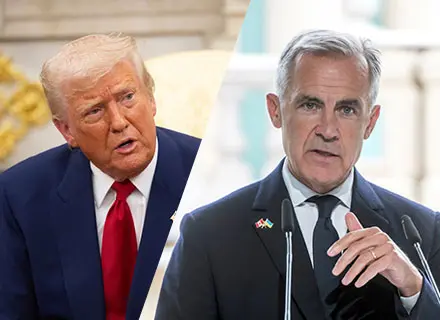

In what seems to be a reprieve for Ottawa, United States President Donald Trump has announced a three-day pause on new 50% tariffs that was set to go into effect on Canadian goods, stating that Washington had reached a truce with the Mark Carney administration.
Carney, while confirming the news from his end, sounded cautious as he remarked, ”Substantial progress has been made, although there is important work still to be done.”
Trump’s Truth Social post said that the Republican paused the tariffs “based on the fact that Canada and the USA, subject to the finalization of documents, have a DEAL.”
Trump and Carney spoke on Tuesday afternoon, their second conversation this week. Their negotiators, however, have been involved in weeks of intense, in-depth talks regarding the sticky points affecting the bilateral trade between the North American nations.
“While we continue this work, Canada remains focused on building a stronger, more independent, and more competitive economy at home,” Carney said.
US Trade Representative Jamieson Greer’s office said the deal will include “comprehensive market access for all American goods, economic security commitments, digital trade alignment, and other provisions.”
Through a proclamation posted on the White House website, Trump also announced that he had received Canada’s commitment to address Washington’s concerns regarding duties on dairy products, alcoholic beverages, and motor vehicles.
However, neither American nor Canadian officials have issued detailed statements to follow up on Trump’s proclamation.
During the discussions between Washington and Ottawa, existing American auto tariffs reportedly became a contentious issue.
Trump added in his social media post that the Keystone XL pipeline—a project canceled by former President Joe Biden in 2021 after years of indigenous and environmental opposition—”may be awoken from the grave,” but did not provide details.
The latest Canada episode also serves as a glaring testimony of how the Trump administration, since 2025, has made tariffs a central pillar of its foreign and trade policies despite legal setbacks and criticism from analysts and trade and geopolitical experts.
As per the Canadian trade experts and industry officials, had the new tariffs gone through, they could have resulted in job losses and business closures in vulnerable sectors like lumber, wine, and dairy. They also cautioned that the dispute complicates broader USMCA negotiations, where Washington is again attempting to gain an advantage over its traditional American partners.
Canada’s minister responsible for US trade, Dominic LeBlanc, and Chief Trade Negotiator Janice Charette have been in Washington since last week for talks. On Monday (August 17), the Canadian officials met for nearly two hours with Greer and Commerce Secretary Howard Lutnick.
As per the reports, Greer repeatedly cited Canada’s tariffs as the reason behind Washington’s counter moves, while blaming Canada’s dairy management system and provinces’ refusal to stock American liquor, among other U.S. grievances.
The Distilled Spirits Council of the United States, while applauding Trump’s stand to protect the beverage industry, also called for “a negotiated solution that gets American spirits back on retail shelves in all Canadian provinces and returns the spirits sector to a zero-for-zero tariff framework.”
Both Washington and Ottawa have also discussed cutting US Section 232 tariffs on Canadian vehicles to 15% from 25%, with further reductions based on the amount of American content in each vehicle.
A major point of contention arose over how to count tariff deductions based on content. Washington pushed for the consideration of all North American content, including Canadian and Mexican parts. Canada advocated for the inclusion of all North American content, encompassing Canadian and Mexican parts, in the calculations.
On August 18, the US Commerce Department released new rules for automakers exporting from Canada and Mexico to certify their current levels of US content for tariff deductions, reducing the complicated exercise to once per year from twice.
However, the notice also said that the automakers must re-certify vehicles’ American content by September 30 for them to claim deductions in the new annual cycle starting December 1.
However, getting the 50% tariffs stalled was just one of the key political tasks that the Carney administration has been able to pull off. The Prime Minister now faces the test of selling any concessions to a domestic audience that remains frustrated with, and skeptical of, the Trump administration’s intent with Ottawa, as well as securing buy-in from Canada’s provinces.
Washington’s request to Canada to lift the ban on American alcohol sales, imposed by most provinces in early 2025 in retaliation for Trump’s tariffs, will depend on how local governments handle the issue, as they have control over alcohol sales within their own jurisdictions.
Ontario Premier Doug Ford, known for his tough stance on the US, stated last week that any agreement regarding alcohol was contingent. He said Ontario would restore American alcohol to shelves only if Canada secured a fair deal shielding its steel, automobile, forestry, agriculture, and manufacturing sectors.
Carney may also face resistance over dairy concessions, particularly in Quebec, where Premier Christine Frechette has said the province’s supply management system is non-negotiable. Trump has argued the system, which sets production quotas, pricing, and import limits on dairy, eggs, and poultry, is unfair to American farmers seeking access to Canada.
Public appetite for concessions appears limited. A new poll from Abacus Data found that 74% of Canadians believe the trade dispute has affected their household, while 36% want Ottawa to respond with new counter-tariffs even at the risk of further domestic economic pain. Only 18% supported concessions such as lifting provincial bans on American alcohol in exchange for reduced US tariffs.