
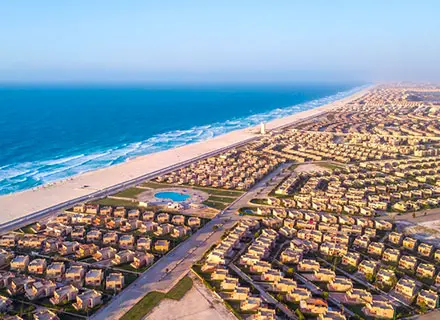

Egypt’s Mediterranean North Coast is emerging as the Gulf’s latest property and tourism frontier, as developers from the UAE and Qatar pour billions of dollars into projects designed to transform a largely seasonal holiday strip into a year-round international destination.
The ambition is bigger than building another collection of luxury resorts. Gulf-backed developers are creating entire cities, complete with hotels, residences, marinas, entertainment, retail, infrastructure, and transport links, betting that Egypt’s long Mediterranean coastline can become a destination to rival established hotspots such as the French Riviera, Greek islands, and Ibiza.
At the center of the transformation is Ras El-Hekma, where Abu Dhabi-backed Modon is leading development of a USD 35 billion project agreed upon between Egypt and the UAE in 2024. The development is expected to attract as much as USD 150 billion in investment over its lifetime and create a new coastal city with residential, tourism, and commercial districts.
The scale of the project has changed the investment landscape along the coast. UAE-backed developments are being joined by Qatar’s Qatari Diar, which has launched the first phase of its USD 29.7 billion Alam Al Roum development.
The project, east of Marsa Matrouh, is planned as a mixed-use tourism and residential destination, with first-phase handovers scheduled from 2030. Qatari Diar says the wider development could create more than 250,000 direct and indirect jobs.
For Gulf investors, the attraction is partly geographic. Egypt offers a long Mediterranean coastline, warm weather, relatively short flying times from the Gulf, and a large domestic population.
For Egypt, the projects provide foreign capital, employment, and infrastructure at a time when the government is seeking investment to strengthen the economy and reduce pressure on its finances.
The property market is already responding.
North Coast real estate transactions reached about EGP 1.2 trillion over two years, accounting for 36% of Egypt’s total property sales, according to developers cited by Ahram Online. Hotel occupancy on the coast was also expected to exceed 95% during the 2026 summer.
The latest sales figures underline the concentration of demand around large, integrated developments. SouthMED, developed by Talaat Moustafa Group, Palm Hills Developments’ Hacienda Ras El-Hekma, and Modon’s Wadi Yemm, generated combined sales of about EGP 258 billion between January and August 15, according to consultancy The Board Consulting.
Modon’s Wadi Yemm alone has recorded cumulative sales of about EGP 144 billion since its October 2025 launch.
Modon is also pushing the hospitality component needed to make Ras El-Hekma more than a second-home market.
In May, it announced a partnership with Montage Hotels & Resorts for Montage Ras El-Hekma, which will include 200 guestrooms and suites and 96 branded residences.
The resort aims to anchor the wider destination by offering restaurants, wellness facilities, events, and leisure infrastructure.
Other developers are following the same model. Palm Hills has partnered with UAE-based Miran Hills on a 5.65-million-square-meter luxury project at Ras El-Hekma, including more than 4.8 kilometers of beachfront, hotels, residences, sports facilities, restaurants, and wellness amenities.
Egypt’s strategy is also shifting towards longer stays. The government has required that 50% of units in North Coast tourism developments be hotel accommodation, an attempt to prevent the coastline from becoming dominated by properties occupied only during the summer.
New Alamein, meanwhile, is being developed as a broader urban center incorporating conference facilities, education, entertainment, and heritage attractions, alongside thousands of hotel rooms.
That year-round ambition is crucial. Historically, the North Coast has been overwhelmingly dependent on Egyptian holidaymakers during the summer months.
The emerging Gulf-backed model seeks to attract international tourists, wealthy Gulf visitors, yacht owners, and longer-stay residents, creating economic activity outside the traditional June-to-September peak.
Infrastructure will determine whether that vision succeeds. A truly international destination requires airports, roads, marinas, hotels, restaurants, and entertainment that can operate throughout the year. The Ras El-Hekma masterplan is therefore as much an infrastructure project as a property development. Gulf capital is helping finance the physical foundations for an entirely new tourism economy.
The competitive positioning is already becoming apparent. Developers are increasingly marketing the North Coast as a Mediterranean lifestyle destination rather than simply a place to buy a holiday apartment.
New projects emphasize beach clubs, branded residences, yacht facilities, wellness, dining, and entertainment—amenities designed to attract visitors who might otherwise choose destinations in southern Europe.
For Gulf developers, there is another strategic attraction: Egypt’s enormous domestic market provides a built-in customer base, while international tourism offers longer-term upside. The combination reduces reliance on overseas buyers compared with smaller Mediterranean markets.
But the bet carries risks. Egypt remains vulnerable to currency volatility, inflation, and geopolitical shocks, while converting a seasonal destination into a year-round international tourism hub requires sustained investment and reliable connectivity.
The magnitude of the commitments indicates that Gulf investors are willing to adopt a long-term perspective.
With billions already committed by Abu Dhabi and Qatar, and Egyptian developers expanding alongside them, the North Coast is becoming one of the Mediterranean’s largest active development zones.
The prize is potentially substantial: a new Egyptian Riviera where property, hospitality, and tourism reinforce one another.
For the Gulf, it represents an opportunity not simply to sell homes on Egypt’s coast but to help build the next major Mediterranean destination from the ground up.