
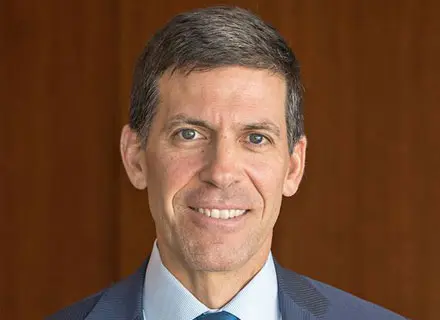

John Waldron has dedicated over 25 years to advancing within Goldman Sachs. Now, after years of being regarded inside and outside the bank as David Solomon’s heir apparent, the 57-year-old president and chief operating officer is edging closer to the top job.
Goldman Sachs’ board has discussed a succession plan under which Waldron could replace Solomon as chief executive, potentially around the end of 2027 or in 2028, according to people familiar with the matter cited by The Wall Street Journal.
Solomon could subsequently remain at Goldman as executive chairman for one to two years, the report said.
The discussions, however, do not amount to a final decision. Goldman’s global head of communications, Tony Fratto, said the board regularly discusses succession as part of its governance responsibilities and that there was “no definitive timeline” for a change at the top.
Any assertions about the timing, he said, were speculation.
That caveat notwithstanding, the latest reports underline how far Waldron’s status has evolved. For several years, he has been widely viewed as the natural successor to Solomon.
His position was strengthened substantially in 2025 when Goldman appointed him to its board and awarded him an USD 80 million retention package designed to keep him at the firm through January 2030.
The award was made to both Solomon and Waldron and was explicitly described in Goldman’s proxy filing as part of the board’s effort to “maintain a strong succession plan for the future of the firm.”
The restricted stock units have five-year cliff vesting and are subject to continued service.
From Bear Stearns to Goldman’s inner circle
Waldron’s Goldman career began in 2000, when he joined the investment bank after working alongside Solomon at Bear Stearns. He quickly established himself as a dealmaker and was made a managing director in 2001 and a partner in 2002.
His early Goldman career included senior roles in leveraged finance and media and entertainment before he became global co-head of the Financial Sponsors Group. From 2009 to 2014, he was global head of Investment Banking Services and Client Coverage. He then became co-head of Goldman’s Investment Banking Division in 2014.
The investment-banking background is significant. Waldron helped oversee some of Goldman’s most important corporate relationships during a period when mergers, acquisitions, and underwriting remained central to the firm’s identity.
In 2018, when Solomon was preparing to take over from Lloyd Blankfein, Waldron was promoted to president and COO. Solomon said at the time that he had worked with Waldron for nearly two decades and was confident that he and other senior executives had the right combination of skills to help lead Goldman.
ALSO READ | Goldman opens its new engineering office in Bellevue, to house AI and cloud professionals
Solomon specifically highlighted Waldron’s role in executing strategy, growing the client franchise, managing risk and capital, and protecting Goldman’s culture.
That partnership has endured. Waldron has consistently served as Solomon’s second-in-command during the latter’s time as CEO, providing him with a direct view of both Goldman’s strategic growth and subsequent contraction.
The man behind the succession story
Waldron graduated Phi Beta Kappa from Middlebury College in 1992 with a bachelor’s degree in English. Beyond Goldman, he has built an extensive network in international economic and policy circles.
He chairs the International Advisory Board of the Atlantic Council and serves on the executive committee of the Institute of International Finance. He is also associated with the US-China Business Council, the Council on Foreign Relations, the Aspen Economic Strategy Group, and advisory bodies connected to the China Securities Regulatory Commission and the Monetary Authority of Singapore.
His corporate and institutional roles include board positions at the Cleveland Clinic and Lincoln Center for the Performing Arts, as well as trustee positions at Middlebury College and Southern Methodist University.
Within Goldman, his remit has expanded well beyond investment banking. As president and COO, he oversees day-to-day execution, works with senior management across the firm, and co-chairs the firmwide Enterprise Risk Committee.
Goldman’s board describes him as having more than 25 years of experience across the firm, with knowledge spanning its core businesses, strategy, client relationships, and operations. It also credits him with a client-centric perspective and describes him as a champion of the bank’s culture.
Those responsibilities have put Waldron at the center of Goldman’s effort to make its businesses work more closely together under the “One Goldman Sachs” model.
The philosophy is one he has publicly championed. In a Euromoney interview, Waldron said the strategy was intended to put clients at the center of the organisation and better connect Goldman’s different capabilities. He described the cultural component as an investment in people and philosophy, built around partnership and teamwork.
More recently, Waldron has also been closely associated with the firm’s push to improve operational efficiency and deploy technology and artificial intelligence across its businesses.
Goldman’s latest annual report describes One Goldman Sachs 3.0 as an operating model using AI across areas including client onboarding, vendor management, regulatory reporting, lending, enterprise risk management, and sales enablement.
What his colleagues and peers say
Direct public commentary from Goldman colleagues about Waldron’s possible succession has been limited, unsurprising given that the bank has not formally announced a transition.
However, the recorded comments depict a senior executive who is deeply integrated into Goldman’s leadership culture.
Solomon has repeatedly spoken of Waldron as a key partner. When announcing his elevation to president and COO in 2018, Solomon said he had worked with him for nearly two decades.
Goldman’s 2018 annual report also highlighted Waldron among the senior executives surrounding the new CEO and described the leadership team as focused on keeping clients at the center of the firm.
ALSO READ | Goldman Sachs, BofA-led consortium plans 2027 stablecoin launch
Waldron’s relationship with Goldman’s senior ranks was evident again when he marked 25 years at the firm in 2025. In a public post, he described Solomon’s partnership as “invaluable” and thanked colleagues and friends for their support.
Solomon responded by congratulating him and thanking him for their partnership and friendship.
Industry observers have also singled him out. Wells Fargo analyst Mike Mayo has described Goldman’s succession process as unusually telegraphed and said Waldron’s elevation had been anticipated since the retention package and board appointment.
Mayo has also praised Waldron’s accessibility.
In comments reported by Banking Dive, he said that it was only after engaging with Waldron that he had had what he considered a particularly constructive meeting at Goldman, contrasting that openness with the more limited public communication associated with some of the bank’s previous leadership.
There is also evidence of support for Waldron’s emphasis on collaboration from within Goldman.
Former senior executive Jim Esposito told Euromoney that Goldman’s senior leadership had worked together for decades and that those relationships were increasingly being developed further down the organisation.
A continuity candidate
If Waldron eventually succeeds Solomon, the transition would represent considerable continuity rather than a wholesale break with the current Goldman strategy.
Solomon became CEO in October 2018 after Blankfein’s retirement. His tenure initially involved an aggressive push into consumer banking, including the Marcus digital platform and other consumer businesses.
Goldman subsequently scaled back that strategy after the businesses generated substantial losses and refocused its resources on investment banking, trading, asset management, and wealth management.
That refocusing has coincided with a stronger period for the bank. Goldman has benefited from revived dealmaking, strong trading activity, and renewed corporate demand for capital markets services.
Reuters reported that analysts expect Waldron to maintain much of Solomon’s strategic direction, particularly the emphasis on global banking and markets and wealth and asset management.
That would make the succession less about changing Goldman’s business model and more about handing responsibility for the existing strategy to an executive who has helped design and execute it.
There is, however, a potential complication: what happens to the rest of Goldman’s senior leadership.
ALSO READ | With NEOS acquisition, Goldman consolidates its position in active ETF space
Waldron’s promotion would leave the president’s position open and could trigger a reshuffling among senior executives. The Wall Street Journal has identified executives including Dan Dees, Ashok Varadhan, and Marc Nachmann as figures whose roles could be affected by the transition.
That makes succession planning more than a question of replacing one chief executive with another. Goldman will also have to manage the ambitions and retention of the executives below Waldron.
The timing is equally uncertain. Solomon, 64, became CEO in 2018, and some senior Goldman figures had expected him to complete roughly a decade in the role, potentially keeping him in place until 2028.
The reported possibility of Solomon moving to executive chairman would also allow Goldman to retain his experience during a transition while giving Waldron operational control.
For Waldron, meanwhile, the trajectory is unusually clear even if the timetable is not. He has moved from dealmaker to investment-banking chief, then to president and COO, a board director, and one of the most highly compensated executives on Wall Street.
Goldman paid him USD 38 million in 2024 and USD 45 million for 2025, according to its disclosures.
His 2025 retention award was separate from annual compensation, and the board explicitly linked it to leadership stability and succession planning.
The result is a succession story that has been developing in plain sight for years.
Goldman has not formally named Waldron as its next CEO, and it insists no timetable has been fixed. But the combination of his operating role, board seat, compensation arrangements, long relationship with Solomon, and standing across the firm has made the question less about whether he is in the succession conversation than about when the handover might occur.
For now, Goldman’s official answer remains that there is no definitive date. The latest board discussions suggest, however, that the planning for the next chapter is becoming increasingly concrete.
Image Courtesy: Goldman Sachs