
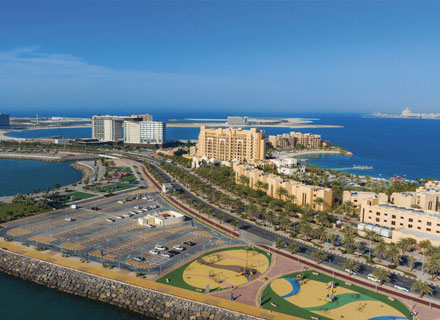

Rising 352 metres out of an artificial archipelago off Ras Al Khaimah, the bronze-and-gold tower of Wynn Al Marjan Island is meant to be seen from a long way off. By the time it opens – now pushed to 2027 after what Wynn Resorts calls a ‘modest delay’ caused by shipping disruptions on account of the Iran conflict, according to comments from chief executive Craig Billings on the company’s investor call – it will be the tallest building in the northern part of the Emirates and the centrepiece of the most consequential experiment in Gulf tourism policy in a generation: The region’s first full-scale, licenced casino.
The numbers alone justify the attention. At USD 5.1 billion, Wynn Al Marjan is more than a resort; it’s a statement of intent by an emirate that until recently was best known as Dubai’s quieter, cheaper neighbour. The property will have 1,530 rooms and suites, 22 restaurants, a 101-berth marina built for superyachts, and a licenced gaming floor of more than 20,000 square metres, plus a second ‘sky casino’ on the 22nd floor.
Analysts have pencilled in annual property cash flow in the USD 450-600 million range, comparing favourably with Wynn’s existing Macau and Boston properties. The company has spoken of revenue potential north of a billion dollars a year once the property matures.
This isn’t a discreet card room appended to a beach resort. It’s designed, unapologetically, to compete with Macau, Singapore and Las Vegas for a slice of Asia’s gaming dollar.
That ambition explains why the project has taken as long as it has to get off the ground, and why it’s worth examining critically. Financing alone required a USD 2.4 billion construction facility (reportedly the largest hospitality financing deal in UAE history) on top of equity contribution from Wynn, Marjan and RAK Hospitality Holding.
Wynn holds a 40% stake in the joint venture, a structure that limits its financial exposure but also its control, more typical of an emerging-market bet than a flagship.
And the ‘modest delay’ language is corporate understatement for a project that’s already weathered a construction pause, materials rerouted around a closed Strait of Hormuz, and a workforce of more than 22,000 labouring through a live regional conflict at its doorstep.
None of this is disqualifying – delays are the rule rather than the exception for integrated resorts at this scale – but the project’s fortunes are tied to a neighbourhood that remains volatile in ways Macau and Singapore simply aren’t.
A licence, not a liberalisation
The regulatory story here matters as much as the architecture. Wynn Al Marjan holds the first, and, so far only, land-based commercial gaming licence issued by the UAE’s General Commercial Gaming Regulatory Authority, a federal body created by decree in 2023 and chaired by Jim Murren, the former chief executive of MGM Resorts.
The GCGRA’s design is deliberately narrow: Each of the UAE’s seven emirates may opt in to a single land-based casino licence and a single online gaming licence, no more. Only Ras Al Khaimah has done so for a physical casino; Dubai, notably, has not, despite MGM Resorts building a large non-gaming hotel there, and reportedly circling an Abu Dhabi application.
Abu Dhabi and Ras Al Khaimah have between them allowed one online operator, Play971, to go live, quietly, in late 2025. This is regulated scarcity, not a free market – a model that borrows more from Singapore’s tightly capped duopoly than from Macau’s crowded strip.
It’s also required real legal engineering. Gambling contracts were, until this year, technically void under the UAE’s civil code even where a GCGRA licence existed. A decree-law that took effect on June 1, 2026, finally removed that contradiction, giving licenced gaming contracts the enforceability investors need – while leaving unlicenced gambling, online and off, a criminal offence.
It’s a narrow, surgical liberalisation: Permission for one heavily vetted operator in one Emirate, wrapped in anti-money-laundering and responsible-gaming obligations pitched, the regulator says, at standards comparable with New Jersey and the UK.
Who exactly will be allowed onto the gaming floor remains one of the project’s more interesting unresolved questions. Early analyst notes assumed Emirati citizens – roughly 10%-11% of the UAE’s population – would be barred outright, consistent with the religious sensitivities involved. More recent regulatory guidance suggests no nationality-based restriction has actually been written into the rules, only an age floor of 21 and valid identification, with final entry conditions to be confirmed closer to opening.
That ambiguity is itself telling: It suggests Abu Dhabi is deliberately keeping its options open rather than committing either way, aware that the answer carries real domestic sensitivity.
Gambling and the Islamic conscience
That sensitivity is not incidental. Gambling – maisir – is explicitly proscribed in the Quran, grouped with intoxicants as a corrupting influence on society, and Islamic jurisprudence across schools treats it as unambiguously haram (forbidden).
It’s this consensus that has kept the Gulf casino-free for decades, and that makes the UAE’s move genuinely startling to many in the region. Riyadh’s approach makes a useful mirror (see sidebar): It shows there’s no single ‘Islamic’ answer here, only a spectrum of political calculations about how far economic diversification can be allowed to stretch religious tradition.
Commentary across the Arab press has been sharp. Critics have accused Abu Dhabi of prioritising tourism revenue over religious and cultural tradition, and of building what amounts to a two-tier system: A foreign-facing playground for tourists, expatriates and global elites – who make up roughly 89% of the UAE’s population – insulated from a citizenry with little formal say in the decision.
Supporters counter that this simply extends a model the UAE has run for decades, from alcohol licencing to Dubai’s nightlife economy: Permissive enough to draw global capital and visitors, calibrated carefully enough not to disturb the domestic social contract.
The market case
The commercial logic isn’t hard to see. Estimates put the UAE gaming market’s potential at $3-5 billion in annual gross gaming revenue, and industry analysts increasingly talk of the country becoming a fourth major global gaming hub behind Macau, Las Vegas and Singapore.
The addressable market is enormous and under-served: Wealthy travellers from India, Pakistan, Iran and the wider Gulf currently fly to Macau, Genting Highlands or, further afield, Las Vegas to gamble. A resort 50 minutes from Dubai International Airport intercepts that demand far more efficiently, alongside European and Russian high rollers already resident in the Emirates.
Wynn’s acquisition of London’s Aspinalls casino, rebranded Wynn Mayfair, looks explicitly designed as a feeder property, channelling British clientele toward Ras Al Khaimah. Regional trend lines support the bet too: Gambling revenue across the Middle East and Africa remains a sliver of the global total but is forecast to grow faster than almost anywhere else through 2031, with the Gulf specifically tipped for growth above 4% annually.
There’s also a wider Asian dimension worth noting. Japan’s own long-delayed integrated-resort experiment in Osaka, and Thailand’s on-again, off-again casino legislation, show how difficult it is even for governments without religious constraints to translate gaming ambition into open floors – years of licencing battles, community pushback, and financing hurdles are the norm, not the exception.
Ras Al Khaimah’s advantage is that it faces none of that domestic political friction: A single ruling family, a compliant federal regulator, and no electorate to persuade. That’s precisely what has let the Emirate move from announcement to near-completion in barely five years, a pace unmatched anywhere else attempting to build an integrated resort from scratch.
Whether Ras Al Khaimah becomes the Macau of the Middle East or a well-financed cautionary tale will depend on execution as much as appetite – on whether the delayed opening holds through 2027, on how strictly access is policed, and on whether Abu Dhabi’s calculated ambiguity toward its own citizens survives contact with a fully operational casino floor. What isn’t in doubt is that the Gulf’s relationship with gambling, quietly settled for half-a-century, has just been reopened for negotiation.