

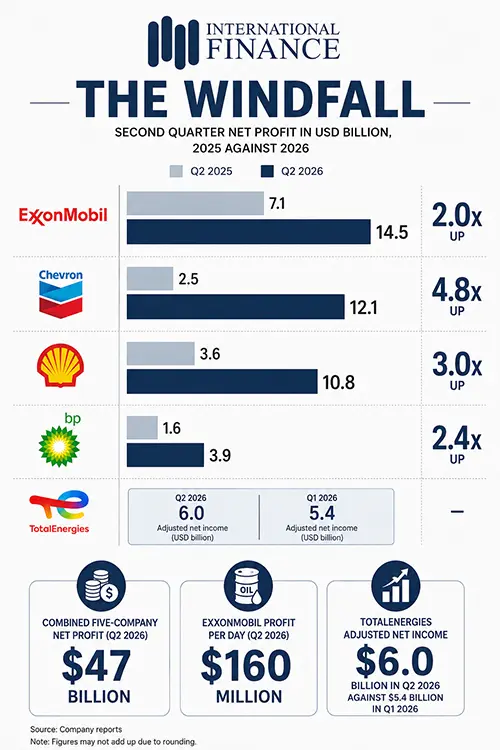
Chevron made USD 12.1 billion, the highest quarterly figure in its history and almost four times the USD 2.5 billion it managed in the same quarter of 2025. Shell reported USD 10.8 billion attributable to shareholders, up 196%. TotalEnergies posted USD 6 billion in adjusted net income. BP, reporting last, doubled its net profit to USD 3.91 billion.
None of these companies discovered a new field, cracked a new technology or cut a transformative deal. What happened, on February 28, was that the United States and Israel attacked Iran, Tehran began attacking shipping in the Strait of Hormuz, and about a fifth of the world’s seaborne oil stopped moving.
Where the money actually came from
The first mechanism is the simplest one in the industry. Once a barrel is in production, most of the cost of producing it is already sunk. Lifting costs, depreciation and overheads barely move when the price does, so almost every extra dollar on the benchmark falls through to the bottom line.
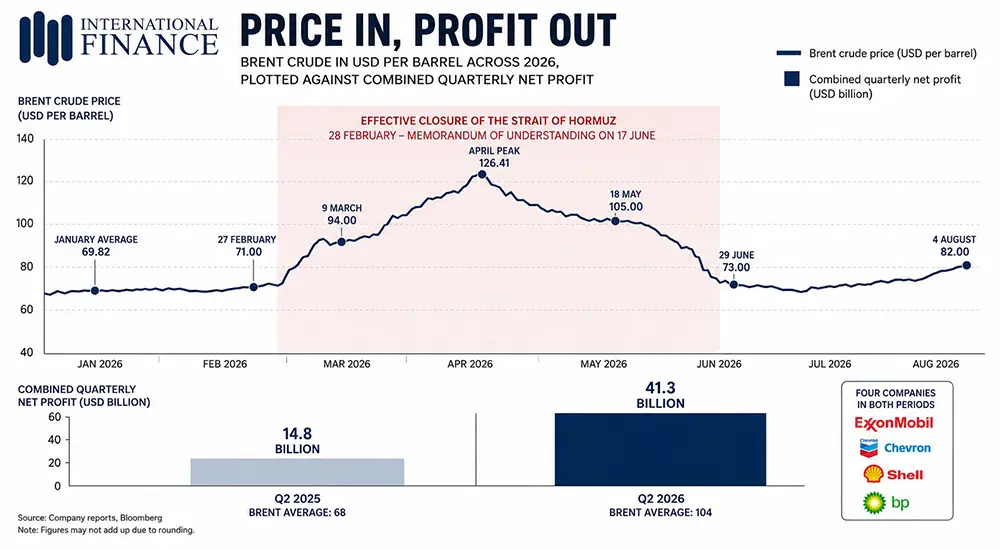
The scale of that extra dollar was extraordinary. Brent averaged USD 69.82 a barrel in January. By late April it had peaked at USD 126.41, the highest print in the past year.
Shell ran its refining network at 102% utilisation, above nameplate capacity, and posted its strongest products result of the decade. Tom Seng, who teaches energy finance at Texas Christian University, has made the point that integrated companies owning both wells and refineries were the best placed of anyone to capture this market.
The third mechanism is integration itself. TotalEnergies chief executive Patrick Pouyanne told markets: In this tense and volatile environment, the strategy of TotalEnergies is once again demonstrating its relevance, taking advantage of our integrated model and the diversification of our portfolio.
A company that produces crude, refines it, trades it and sells the fuel captures margin at four points instead of one.
ALSO READ | Iran war: With just weeks of jet fuel stocks left, how vulnerable is Europe?
American producers also gained a straightforward logistical windfall, with United States crude and product net exports hitting a record 5.8 million barrels a day in April as buyers cut off from the Gulf went shopping in Texas.
Chevron chief executive Mike Wirth said the company was “kind of firing on all cylinders”. US shale is following the same pattern, with ConocoPhillips, Occidental, EOG Resources, Diamondback and Devon all heading for their strongest results since 2022.
Whether any of it lasts
The short answer is no, and the more useful evidence for that is not in the forecasts but in what the companies are doing with the cash.
In 2022, after Russia invaded Ukraine, a windfall of this shape would have triggered a drilling boom. This time it has triggered almost none.
 TotalEnergies prioritised paying down debt, cutting gearing to 13%, and lifted its dividend by 5.9%. Among the shale producers, only Diamondback has explicitly tied higher prices to higher activity. Boards that lived through the busts of 2015 and 2020 are treating this as a cash event rather than a growth signal, which is a fairly clear statement about how long they expect it to last.
Vandana Hari of Vanda Insights described the June collapse bluntly, noting that “crude’s slide is entirely sentiment-driven” and that the market was pricing the best case for reopening.
Forecasts cluster well below current levels for next year. The World Bank expects Brent to average USD 86 in 2026 and USD 70 in 2027. JP Morgan sees USD 75 next year, Morgan Stanley USD 80.
Refining is the most fragile leg. Those margins exist because the world lost processing capacity faster than it lost demand, and capacity comes back. Several import-dependent countries are already reassessing whether to build their own refineries, which points to oversupply on a three to five year view.
There is one counterargument. Inventories in OECD countries are the lowest since 2003, and restocking after a draw that size takes several quarters even once flows normalise.
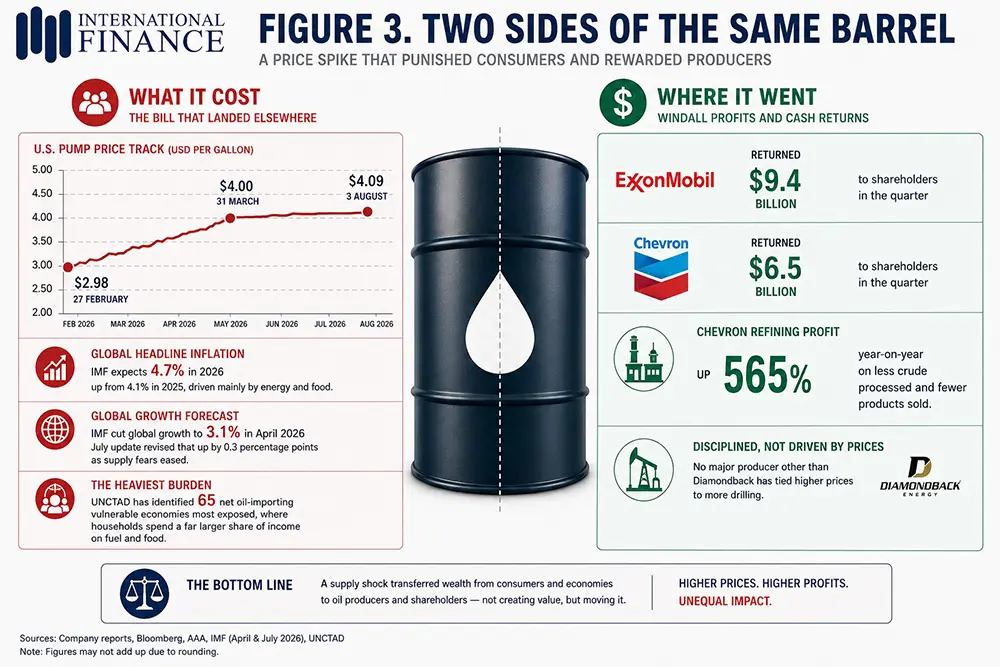
For businesses, the harder problem is planning. Firms surveyed by the Atlanta Fed described conditions as manageable now but risky ahead, and the risk is that fuel costs get written into wages, contracts and pricing, at which point the shock stops being temporary.
The politics catches up
On August 3, United States President Donald Trump broke with his usual position on the industry and said of Exxon and Chevron that “they’re making too much money based on a shortage”, adding that they should give some of it back and cut pump prices.
The American Petroleum Institute responded that prices reflect global supply, demand and uncertainty around shipping lanes rather than the conduct of any single company, which is largely correct and also beside the point being made.
Portugal has already approved a 33% windfall tax on 2026 profits above a 2024 to 2025 baseline. Democrats in the United States Congress have introduced bills to levy a per-barrel tax on large producers and redistribute the proceeds.