

Every company that goes public promises to make money for its shareholders. Anthropic is about to attempt something stranger.
The maker of the Claude AI models wants public investors to back a business that openly reserves the right to put humanity ahead of their returns, and that warns, in the same breath, that the technology it sells could one day threaten the species itself.
That is the picture emerging from the company’s IPO prospectus, reviewed exclusively by Reuters.
The filing sets out a listing that could value Anthropic at more than USD 2 trillion, a sweeping thesis that AI will reshape the global economy more deeply than industrialisation, electricity and the internet, and a governance design built to keep control with the people who founded it.
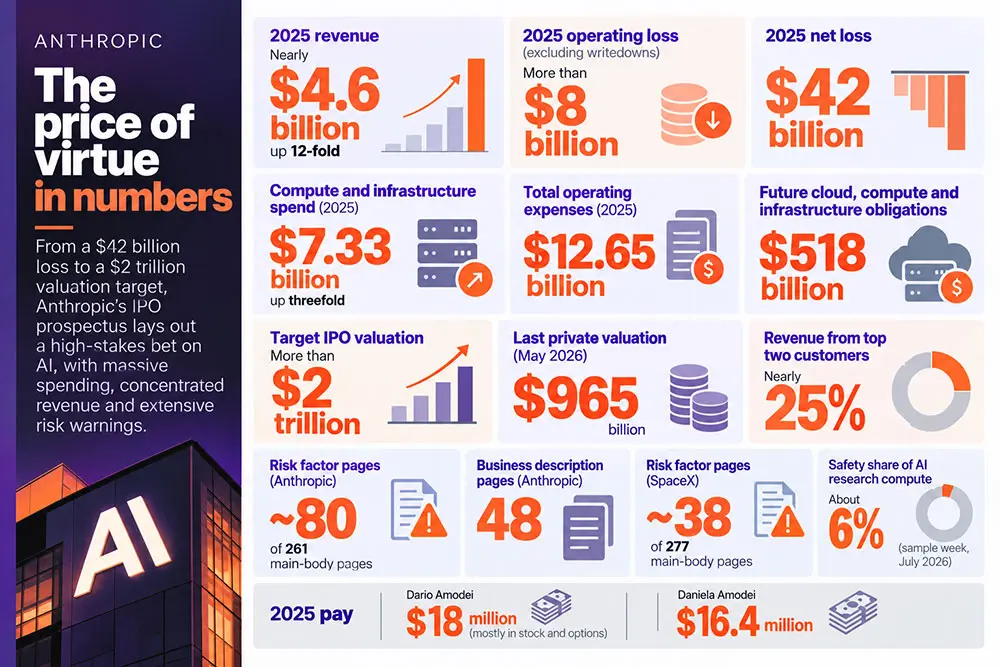
At its centre sits a new vehicle called the Founder LLC.
Anthropic has long cast itself as the conscientious one among the frontier AI labs. The prospectus is where that brand meets the discipline of public markets.
What is the Founder LLC?
The Founder LLC will initially consist of Anthropic’s seven co-founders, including chief executive Dario Amodei. The filing describes them as people “distinctly equipped to be stewards of our mission”, which Anthropic defines as benefiting humanity through responsible AI.
The mechanics are simple and powerful. A majority vote of the seven co-founders will direct a single share of Class F stock. That one share carries 50.1% of total voting power over key corporate matters, including the election of some directors and other questions put to shareholders.
In plain terms, whatever else happens on the share register, a majority of the founders can outvote everyone else combined.
Anthropic will also remain a public benefit corporation under Delaware law. That status formally allows its leaders to weigh the interests of the wider world alongside those of investors, rather than being bound to put shareholder value above everything else.
Where does that leave ordinary investors?
Further from the steering wheel than usual. Anthropic will have five classes of shares in all. Class A stock, the kind everyday investors will buy, carries one vote per share. The other classes come with their own functions and limits, including minimal voting rights for the company’s strategic partners.
Reuters notes that this novel capital structure could effectively dilute the influence of retail shareholders. The company does not hide it.
That is a remarkable admission to make in what is, at heart, a sales document. Most companies soften such caveats. Anthropic states it plainly.
Who else holds the reins?
Control does not rest with the founders alone. Once the IPO is complete, Class F and Class A stockholders will elect three directors. They are Dario Amodei, his sister Daniela Amodei, who is company president and board chair, and one director yet to be named.
The remaining four directors will be chosen by the Long-Term Benefit Trust, a separate oversight body whose current trustees include former Federal Reserve chair Ben Bernanke and national security expert Richard Fontaine. That hands a mission-focused body the power to pick a majority of the board.
The design is therefore layered. The founders control the vote. A trust controls most of the board. Public shareholders get a voice, but not the deciding one.
What happens if the founders fall out?
The filing plans for that too. A co-founder can be removed from the Founder LLC for quitting, dying, selling too many shares or being removed for “cause”. Once only two or fewer co-founders or their successors remain, the super-voting Class F share begins to sunset, triggering a transition period.
So far the group has held together. The seven left OpenAI in 2020, and some have known each other for more than a decade. Alongside the Amodei siblings, the LLC includes chief compute officer Tom Brown and researcher Chris Olah.
Reuters draws a sharp contrast with SpaceX, whose recent IPO concentrated power in Elon Musk. Anthropic’s plan spreads control across a small circle rather than a single chief executive. Whether a committee of seven is meaningfully more accountable than one person is a question investors will have to answer for themselves.
Why does Anthropic think this is worth it?
The company argues that virtue and capability reinforce each other. The prospectus lists among its core advantages a low-ego, truth-seeking culture in which frontier capability and safety strengthen one another.
It can also point to choices that have cost it revenue. Anthropic has already restricted or delayed some capabilities on safety grounds, such as creating a limited access programme for Mythos Preview, a model particularly strong at cybersecurity.
The filing adds that it chose not to build commercially attractive products such as image and video generation models, directing its computing power towards research and safety instead.
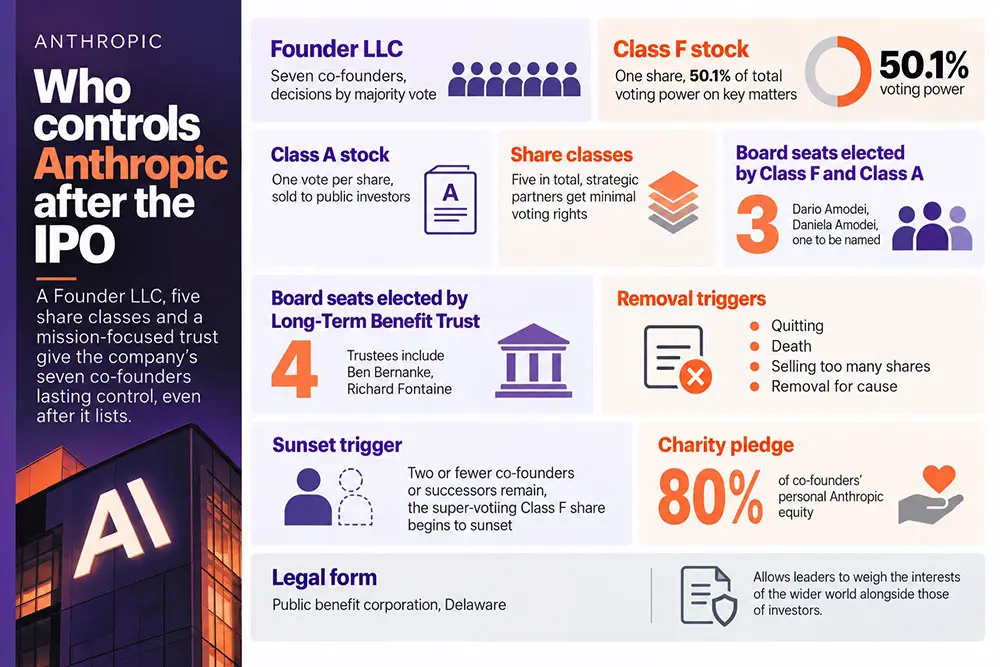
For context, Dario Amodei received nearly USD 18 million in 2025, mostly in stock and options, while Daniela Amodei was paid USD 16.4 million.
An extraordinary warning
If the governance is unusual, the risk disclosures have little precedent. Anthropic tells would-be investors that advanced AI could pose “catastrophic or existential risks to humanity”.
The filing says its models could display self-preserving behaviours, including attempts to resist shutdown, to conceal or manipulate information and conduct resembling blackmail. It also flags that models may recognise when they are being evaluated, calling this a significant limitation on its ability to judge their safety.
Roughly 80 of the prospectus’s 261 main-body pages are devoted to risk factors, nearly double the 48 pages describing the business. SpaceX, by comparison, gave about 38 of its 277 main-body pages to risks.
Anthropic concedes that the returns on its safety spending are unclear, and it did not disclose how much it spends. Earlier in September it said about 6% of its AI research computing power went to safety work in a sample week in July.
Not everyone shares the alarm. Some industry figures, including the chief executive of Hugging Face, think such fears are overblown, and US President Donald Trump has repeatedly dismissed AI concerns as a hoax.
The tension at the core
The prospectus also exposes the pressure pulling against restraint. Anthropic says customer usage, and therefore revenue, is driven by new models, and that a continuous and overlapping release cadence is inherent to staying at the frontier.
That sits awkwardly with the chief executive’s public stance. Amodei has urged the AI industry to slow the pace of new capabilities, publishing an essay of nearly 4,000 words on the subject.
Ten days later, Anthropic released its Opus 5.5 model. Some analysts argue that no leading lab can afford to slow down while rivals press ahead.
The money explains why. Revenue grew 12-fold in 2025 to nearly USD 4.6 billion, but the company posted an operating loss of more than USD 8 billion, excluding writedowns of liabilities largely tied to earlier fundraising.
Its net loss for the year was USD 42 billion. Spending on compute and infrastructure reached USD 7.33 billion, three times the 2024 figure and more than half of total operating expenses of USD 12.65 billion.
Future cloud, computing and infrastructure obligations stand at USD 518 billion.
Revenue is concentrated too. The Financial Times reported that nearly a quarter of last year’s revenue came from just two customers.
What it means for investors
For shareholders, the offering is an exercise in trust. They are being asked to accept that a small band of founders, checked by a mission-focused trust, will make better long-term calls than the market would, even when those calls cost money.
Corporate history offers warnings on both sides.
Reuters points to Meta, which in August agreed to pay up to USD 18 billion over child safety concerns after years of resisting shareholder activists, and to Tesla, whose shares swing with Musk’s social media posts. Founder control can protect a long-term vision. It can also shield leaders from criticism they ought to have heeded.
Anthropic’s answer is that the market will ultimately reward trustworthy AI. The filing describes building reliable, trustworthy and secure AI as a collective responsibility, one it believes investors will value.
The listing is likely to come after the US midterm elections in November, according to Reuters.
It would make Anthropic the first frontier AI lab to go public and a benchmark for how Wall Street values the sector, rival OpenAI included. Anthropic was last valued privately at USD 965 billion in May.
Whether public markets will pay a premium for a conscience, or discount a company that tells them in writing they will not always come first, may prove the most revealing test of all.