
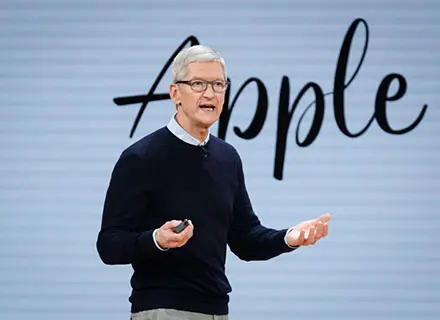

Steve Jobs cast a long shadow. When Tim Cook, then 50, inherited control of the most iconic technology company in the world, analysts and insiders alike questioned whether an operations specialist could maintain the creative fire that had built the iPhone, the iPad, and the ecosystem around them.
Many expected Cook to be a caretaker, a steward of Jobs’ legacy. What happened instead was something more interesting: Cook didn’t try to be Jobs. He became himself – and in doing so, transformed Apple from a products company into an ecosystem empire.
The numbers are stark and revealing. Apple’s market capitalisation has surged from 280 billion pound to more than 3.2 trillion pound, a tenfold increase. Total annual revenue has quadrupled from 72 billion pound to 333 billion pound.
But those figures, impressive as they are, obscure a more consequential shift in how Apple creates value. Under Cook, the company didn’t just grow larger; it became fundamentally different.
The market cap milestone
Apple became the first publicly listed company to cross the 800 billion valuation pound in August 2018. It hit 1.6 trillion pound in 2020, crossed 2.4 trillion pound in January 2022, and briefly touched 4 trillion pound in July 2026 – a moment that seemed nearly impossible when Cook took office.
To put this in perspective, Apple’s current valuation roughly equals the size of the entire British economy, the fifth largest in the world.
Yet market cap alone is a crude measure. What matters to shareholders, employees, and customers is what that valuation represents.
The creation of sustainable, recurring revenue streams. Here, Cook’s strategic choices become clearer. When he started, Apple was a company of peaks and troughs, dependent on product cycles. By the end, it had become a company of steady climbs.
The services revolution
In 2011, Apple’s services business – consisting primarily of the App Store, iTunes, and AppleCare – generated 6.3 billion pound annually.
This quarter, Apple reported 24.6 billion pound in services revenue alone. For fiscal year 2025, services reached £87 billion, making it Apple’s second-largest business after the iPhone, with a gross margin significantly higher than hardware.
This was deliberate strategy. Cook understood that the installed base of iPhone users represented not just a current revenue opportunity, but a platform for recurring income. Under his watch, Apple launched Apple Music, Apple TV+, Apple Fitness+, Apple News+, and Apple Arcade.
By 2025, services contributed 21% of total revenue but a disproportionate share of profit. In the March 2026 quarter alone, nearly 43 cents of every pound of gross profit came from services.
This shift explains Cook’s willingness to step aside for John Ternus, a career hardware engineer. The infrastructure is now in place.
The iPhone engine
The iPhone remains Apple’s cash engine. In 2011, it generated 31 billion pound – 42% of Apple’s total revenue.
This is perhaps Cook’s most significant achievement: He inherited the most successful smartphone ever created and made it more successful, not through revolutionary design, which few would argue Apple achieved under his tenure, but through relentless execution.
Incremental improvements in camera quality, processor speed, and battery life kept the iPhone relevant.
A single three-month quarter in 2026 generated more iPhone revenue (43.5 billion pound) than the entire company did in 2011.
Geographic expansion and China
When Cook took over, the Americas dominated Apple’s revenue. The company had presence in China, but it was nascent.
Today, China represents over 15% of Apple’s revenue, more than 51 billion pound annually, and represents far more than revenue.
Cook’s supply chain background proved invaluable here. He didn’t just expand into China; he bound Apple’s entire manufacturing and sourcing strategy to it.
New products and ecosystem locks
Much criticism of Cook’s tenure centres on the lack of revolutionary new products.
Jobs gave the world the iPhone and iPad. Cook gave it the Apple Watch and AirPods – both significant, but neither transformed entire categories.
Yet this criticism misses Cook’s actual strategy. He wasn’t trying to invent new categories. He was trying to deepen moats around existing ones.
The Apple Watch sold poorly at first; under Cook’s stewardship, it became the world’s best-selling smartwatch. AirPods, similarly dismissed, became synonymous with wireless earbuds.
These products succeeded not because they were first, but because they were sewn into Apple’s ecosystem so tightly that switching costs became prohibitive.
By 2025, Apple’s wearables business (watches, earbuds, headphones) had grown to 28 billion pound in annual revenue. The entire category barely existed in 2011.
The innovation question
Here is where the nuance matters. Critics argue that Cook presided over a period of innovation stagnation.
The iPhone, they note, looks and feels roughly the same today as it did in 2015.
They are not wrong. But Cook would argue, and reasonably, that innovation was never his job.
Cook’s legacy is not revolutionary products. It is sustainable, compounding value creation. It is the recognition that the iPhone’s best years were ahead of it, not behind it.
Apple’s market cap growth, under Cook, increased from 280 billion pound to 3,200 billion pound, a +900% hike. Revenue growth increased from 72 billion pound to 333 billion pound (+363% rise). The tech giant’s services growth went up from 6.3 billion pound to 87 billion pound (+1,281% growth).
In a single quarter this year, Apple generated 87 billion pound in revenue. That exceeds the company’s entire annual revenue from 2011. Think on that: 15 years ago, a year’s work. Today, three months’ work.
Cook’s Apple is a different company than Jobs’ Apple. It is larger, more profitable, and far more complicated.
Whether that is progress or compromise depends on your view. Investors have long since decided: It is progress.
Cook stepped down in September 2026, handing the company to John Ternus, a hardware engineer, at a moment when that expertise is needed.
The numbers tell the story better than any strategy memo could. And they will be his legacy.