


The world’s largest bond markets sold off together this week, and the numbers tell the story better than any commentary can.
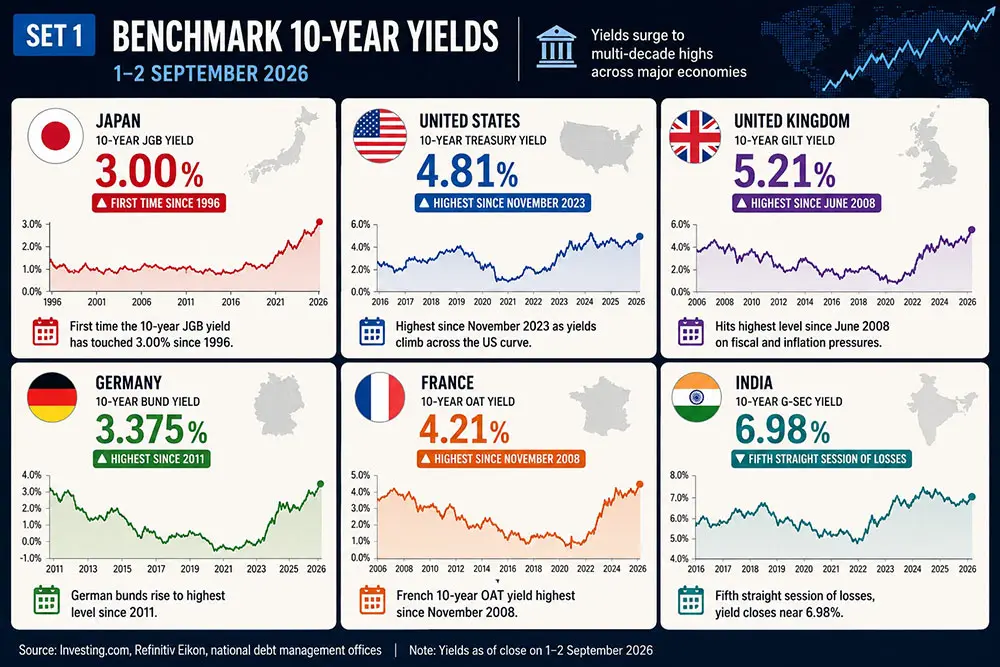
On September 1, the yield on Japan’s 10-year government bond touched 3% for the first time since 1996, while the five-year hit a record 2.26%. In the United States, the 10-year Treasury yield climbed to about 4.81%, its highest since November 2023, and the 30-year sat near 5.3%, a level last seen roughly 19 years ago.
British 10-year gilts pushed above 5.2%, the highest since June 2008. German bunds, the euro area benchmark, reached 3.375%, their highest since 2011. France’s 10-year OAT rose above 4.21%, last seen in November 2008.
Spanish, Italian and Dutch yields hit multi-year highs the same day.
That is not a local accident. It is a synchronised repricing of the cost of money across the developed world, driven by three forces that have converged at the same moment.
An energy shock that will not fade
The first force is oil. Brent crude jumped about 5% on September 1 to near USD 95 a barrel, a six-week high, after American forces struck Iranian targets around the Strait of Hormuz following attacks on two tankers there.
It caps a year in which the US and Israeli war on Iran has repeatedly crippled a chokepoint that normally carries about a fifth of the world’s daily oil flows. Brent traded above USD 110 in March, and dated cargoes briefly cleared USD 140, the highest since 2008.
Energy prices sit at the front of every inflation forecast, and bond investors know it. The war has done something more damaging than push prices up once.
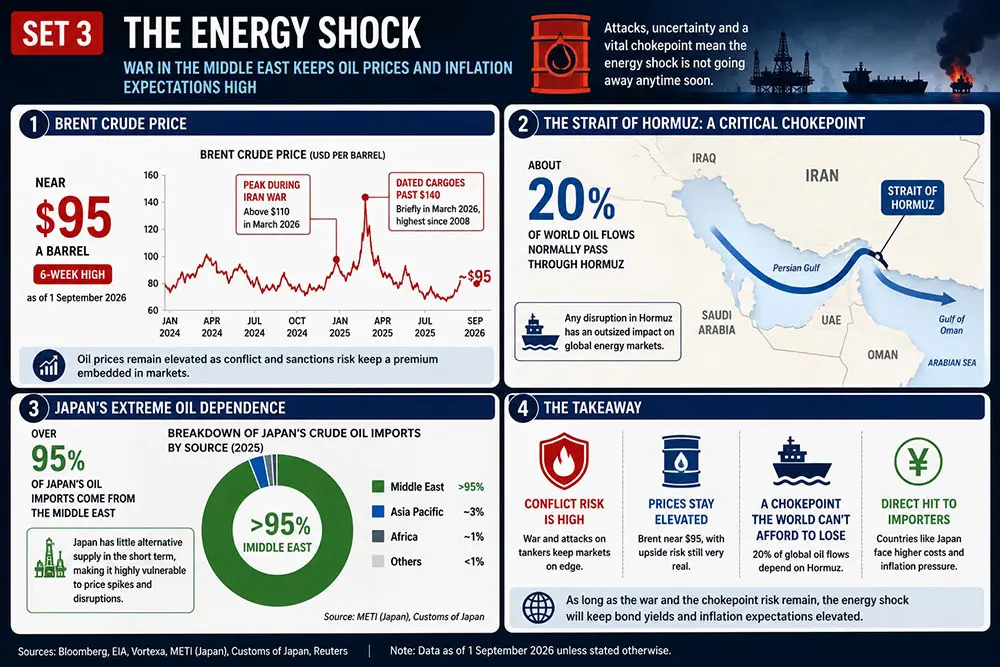
Markets had read new Federal Reserve chair Kevin Warsh’s hawkish Jackson Hole remarks as the moment long-end yields would settle. Renewed fighting and dearer crude killed that idea within days.
Governments that cannot stop borrowing
The second force is fiscal, and Japan is the clearest case. Tokyo expects debt servicing costs to rise 17% to a record 36.64 trillion yen, about USD 230 billion, next fiscal year, on an assumed interest rate of 3.8%, the highest in 29 years.
Prime Minister Sanae Takaichi wants to cap new issuance at around 40 trillion yen for the fiscal 2027 budget, a promise aimed at reassuring investors ahead of a fourth straight year of record spending and a planned tax cut on food.
Britain has its own version. Andy Burnham became Prime Minister in July and installed John Healey at the Treasury, and gilt yields moved almost at once on his suggestion that he would seek flexibility within the fiscal rules. The autumn budget is now the event gilt investors are watching.
In the United States, federal interest payments now exceed combined spending on Medicaid, national defence and all non-defence discretionary programmes.
France carries a persistent risk premium over Germany tied to its budget process and the 2027 elections. Investors are asking a question they had not bothered with for fifteen years, which is who buys all this paper, and at what price.
The AI borrowing wave
The third force is new, and most investors underestimated it. The AI buildout has moved from an equity story to a fixed income story.
Alphabet, Amazon, Meta, Microsoft and Oracle issued roughly USD 121 billion of bonds in all of 2025, more than four times their 2020 to 2024 annual average. By early June 2026 the same five had raised about USD 159 billion.
Broader AI-related issuance, taking in data centres, chip financing and project vehicles, has reached roughly USD 500 billion this year, around 18% of total US investment grade supply, up from about 7% in 2025 and roughly 1% in 2024.
The paper is unusually long dated, because data centres are long-lived assets.
S&P estimates the five will spend about USD 750 billion on capital expenditure in 2026, equal to 38% of their combined revenue.
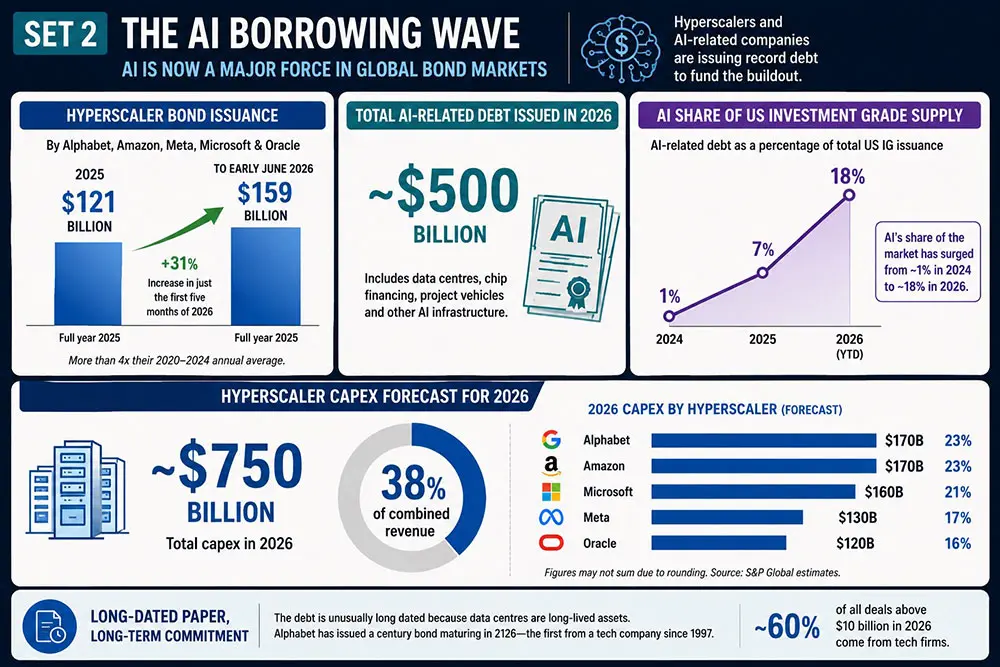
The effect is mechanical. A huge quantity of high-grade duration is being pushed into the same part of the curve where governments must fund themselves, just as central banks shrink their own holdings.
Sovereign issuers are now competing directly with Big Tech for the same buyers, and they are not obviously winning. Of 91 hyperscaler bonds issued in 2026 with comparable pricing data, 78 were trading at higher yields in late July than when they were sold.
Tariffs, and the hole they left behind
Tariff warfare has fed the rout from both directions. Through 2025 and early 2026 the American effective tariff rate climbed to nearly 17%, the highest since the early 1930s, and New York Fed research found that close to 90% of the cost fell on American firms and consumers.
That was imported inflation, and it hardened the price expectations now embedded in long yields.
Then, on February 20 2026, the Supreme Court ruled that the International Emergency Economic Powers Act does not authorise the president to impose tariffs, striking down the reciprocal duties.
The administration pivoted to Section 122 of the Trade Act of 1974 and to existing Section 232 and 301 powers, and the average effective rate fell to about 7.1% by June. But the ruling erased a large expected revenue stream and opened the door to refunds estimated at up to USD 175 billion.
A government that loses tariff income without cutting spending borrows the difference, and the bond market has priced exactly that.
Where equities feel it
Global equity indices have absorbed the move so far, but cracks are visible underneath.
The MSCI All Country World Index remains near a record, while the technology-heavy Nasdaq Composite is down almost 4% from its June high. The damage is showing up sector by sector rather than in the headline number.
Long-duration growth stocks are the most exposed, because a higher discount rate compresses the value of profits expected years out. That hits the same technology names now issuing the debt, creating a loop in which the AI trade raises the cost of the capital it depends on.
Utilities and real estate, the classic bond proxies, suffer directly. Investors who held them for income can now get a comparable return from government paper without taking equity risk.
Banks and insurers are the relative winners, because lenders earn a wider spread as the curve steepens and insurers earn more on the fixed income portfolios they must hold. Energy has been among the strongest performing sectors of 2026, for the obvious reason that the thing driving inflation is also driving its revenue.
Housing and consumer discretionary sit at the sharp end. Mortgage rates track the 10-year Treasury plus a risk premium and are at their highest since the summer of 2025, in economies where affordability is already the dominant political complaint. Traders widely regard 5% on the US 10-year as the point at which equity markets stop shrugging.
How governments are responding
On Augusts 19, the United States Treasury said it would at least double its long-dated buybacks, from USD 2 billion to at least USD 4 billion per operation, running from Seotember 9 to November 4, apart from targeting the 10 to 30-year sector, where a buyers’ strike had set in since late June. Yields fell, then erased the move within a day.
Secretary Scott Bessent has since called the figure a floor rather than a limit, and officials have signalled that the roughly USD 1 trillion Treasury General Account could fund larger operations.
Japan is moving the other way, by tightening. The Bank of Japan is expected to raise its policy rate to 1.25% in September, and the finance ministry has repeatedly trimmed super-long issuance to relieve the maturities where fiscal anxiety concentrates.
Tokyo and Washington intervened jointly in the yen in July, partly to reduce the risk that Japan sells US Treasuries to raise dollars.
The Federal Reserve meets on September 15 and 16 with markets pricing roughly a two-thirds chance of a rise, and the European Central Bank (ECB) faces similar pressure as euro area inflation runs above target on energy.
Emerging markets are absorbing the consequences without the tools to resist them. Indian government bonds fell for a fifth straight session on September 2, the benchmark closing near 6.98%, with traders pointing to 7.15% if American yields keep climbing.
India imports most of its crude, and the gap between Indian and US 10-year yields is near a multi-year low, weakening the case for foreign portfolio money to stay. Yields also rose from South Africa to South Korea and Poland.
Perspective
For all the alarm, this is not 2022. Global government bond yields have risen about 17 basis points on a rolling 20-day basis, against 62 at the peak of the last rout, and bonds have lost roughly 4.2% peak to trough this year rather than 23%.
The difference is that 2022 was a shock with a visible end, once central banks had done their work. This one has three engines running at once, and none of them switches off on its own.