
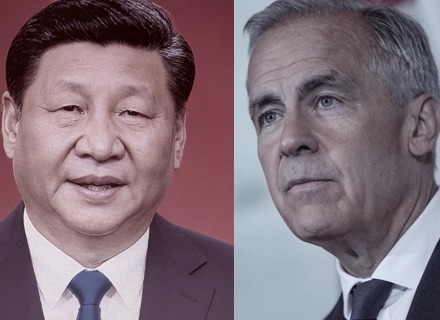

Canada and China are moving to deepen their trade and financial links. Both Ottawa and Beijing have agreed to improve access for financial institutions, increase local currency cooperation and cut trade barriers in key sectors at a meeting in Shenzhen ahead of the recent APEC Summit.
The moves are part of a broader strategy by Canadian Prime Minister Mark Carney to diversify the country’s international economic ties and reduce dependence on the United States, as trade deal progress remains slow.
“The arrangements would give both economies the tools to respond more effectively during periods of financial stress,” he added.
“When our businesses depend on too few currencies or single payment channels, disruption, when it comes, can spread quickly,” Carney said.
The Canadian prime minister also confirmed that Ottawa and Beijing had renewed their bilateral currency swap arrangement through their respective central banks.
The agreement allows the two countries to exchange each other’s currencies, supporting financial transactions and potentially reducing dependence on third-party currencies and payment channels.
China’s Finance Ministry separately said both countries welcomed steps by their central banks to implement the local currency swap arrangement.
They also encouraged qualified Canadian financial institutions to issue Panda bonds, which are yuan-denominated securities sold in China’s domestic bond market.
The financial cooperation comes as Canada attempts to recalibrate its economic relationship with China following several years of diplomatic and trade tensions between Ottawa and Beijing.
Reducing Canada’s dependence on Uncle Sam has become a central component of Carney’s economic strategy, particularly after Washington imposed substantial tariffs on several Canadian products.
While noting that the United States remains Canada’s largest trading partner, Carney acknowledged that the economic relationship between the two North American majors was considerably larger and more complex than Ottawa’s ties with China.
“The United States fundamentally changed its trade objectives, and we are focused on getting the right deal for Canadians,” he told reporters following his speech.
Reuters had previously reported Foreign Minister Anita Anand said that Ottawa was slowly rebuilding ties with Beijing after years of strained diplomatic relations.
Carney said that Canada began to recalibrate its relationship with China after taking office in 2025.
Canadian exports to China have increased by more than a third in 2026, while bilateral trade has reached approximately CUSD 125 billion (USD 87 billion).
He added that Canada had restored market access for more than 99% of trade previously affected by punitive tariff measures.
The prime minister also said Ottawa was already ahead of schedule in achieving its target of increasing exports to China by 50% by the end of the decade.
The latest developments indicate that Canada is seeking to expand its access to the Chinese market while maintaining its extensive commercial relationship with the United States.
Trade concessions have emerged as another important part of the improving relationship, with Carney and Xi agreeing to extend and expand a preliminary agreement designed to improve access to the Chinese market for Canadian agricultural producers and seafood exporters.
Under the arrangement, Beijing will provide additional tariff relief on approximately CUSD 400 million (USD 280 million) worth of Canadian exports, including frozen pork cuts, fish and seafood products.
In return, Canada has agreed to extend by two years the existing tariff remission measures covering certain Chinese steel and aluminium products.
These exemptions were originally scheduled to expire at the end of 2026, according to a statement from Carney’s office.
The agreement builds on trade measures introduced following Carney’s January visit to China.
Beijing had previously reduced tariffs on Canadian canola seed and extended tariff relief for canola meal, lobsters, crabs and peas for another two years.
Agriculture and seafood have become important areas of bilateral trade negotiations, given China’s position as a major destination for Canadian agricultural commodities.
Improved market access could provide Canadian producers with additional export opportunities at a time when trade uncertainty with the United States remains a concern due to the Trump tariffs.
Xi said exchanges and cooperation between the two countries had fully resumed across several sectors since their January agreement to advance the China-Canada strategic partnership.
The two leaders have met three times since Carney became prime minister, including discussions on the sidelines of the 2025 APEC summit in South Korea.
According to China’s state-run Xinhua news agency, Xi outlined four proposals for strengthening bilateral relations.
These included improving mutual understanding of each country’s development priorities, expanding cooperation in trade, energy, agriculture and finance, and identifying opportunities in green technology, digital industries and e-commerce.
He also called for stronger cultural and people-to-people exchanges and greater cooperation in supporting the multilateral trading system.
“Stronger communication and cooperation between China and Canada will benefit not only our two countries but also Asia-Pacific and the world,” Xi told Carney.
Beyond agricultural exports, energy has emerged as another area of growing commercial cooperation between the two countries.
Shipments of Canadian crude oil to China increased by approximately 37% in 2026, according to a Reuters calculation based on LSEG data.
The rise points out the value of China as an alternative destination for Canadian energy exports as Ottawa seeks to broaden its customer base beyond North America.
Canada’s energy industry has significant export potential, particularly as Asian economies continue to secure supplies from a variety of international markets.
Greater access for Chinese buyers could open up more commercial opportunities for Canadian producers while helping Beijing diversify its energy imports.
The auto industry is preparing for a tectonic shift in two-way trade.
Chinese automakers BYD, Geely, and Chery are actively expanding their presence in Canada following Ottawa’s decision to allow annual imports of 49,000 Chinese-made vehicles at a tariff rate of 6.1%.
The import quota is set to increase to 70,000 vehicles in five years, potentially providing more opportunities for Chinese auto firms seeking to increase their overseas sales.
This is especially important in the face of increasing global competition in electric cars with Chinese manufacturers building up a large manufacturing and export capacity.
More Chinese vehicles could enter the country’s market, expanding consumer choice and competition, but the arrangement also brings new considerations for the domestic auto industry and its supply chain.
The resumption of the currency swap arrangement and the discussions on Panda bonds show that Canada and China are looking to go beyond traditional merchandise trade to strengthen their financial relationship.
Panda bonds are yuan-denominated bonds issued in China’s domestic capital market by foreign institutions and companies to raise funds.
Additional sources of funding could be made available, and financial linkages between the two countries could be deepened by encouraging eligible Canadian financial institutions to tap this market.
The currency swap agreement could also help boost the availability of Canadian dollars and Chinese yuan for businesses and financial institutions, encouraging cross-border trade.
Such arrangements could help reduce exposure to third-party currency fluctuations, especially the US dollar.