
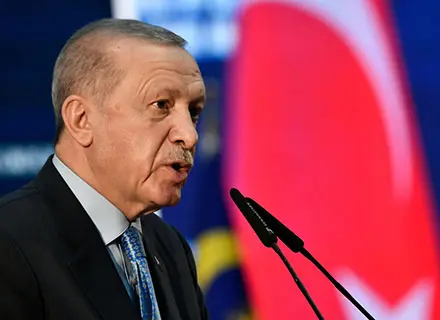

Turkey is to merge its three state-owned Islamic banks, with President Recep Tayyip Erdogan pitching participation finance, often known as interest-free or Shariah-compliant finance, as a “fairer” model for the whole world.
“Participation finance is a fairer and safer model not just for Muslims but for the entire world,” Erdogan told the audience at the recently concluded “Third Global Islamic Economy Summit.”
Ziraat Katilim, Vakıf Katilim, and Halk Katilim banks would be consolidated, with the goal of creating “significant synergy” in the Islamic financial sector.
Erdogan also announced plans for an initial public offering (IPO) of another participation bank, Emlak Katilim, which he said would allow Turkish citizens to become partners in the venture’s growth. The institution was restructured in 2018 from Emlak Bank and has since become a key player in Turkey’s Islamic financial ecosystem.
While describing Islamic finance as being based on justice, ethics, risk-sharing, sustainability, and social welfare, the president also said that “participation finance” and related capital market instruments have gained ground in Turkey’s financial system over the years.
“In the first quarter of 2026, the market value of companies included in the participation index reached 36% of the total market value of companies traded on Borsa Istanbul. The active asset size of 10 Turkish participation banks, three of which are digital, currently stands at more than TL 4.7 trillion (over USD 100 billion),” Erdogan said.
“Their market share within the banking sector has reached 9.5%,” he added further.
Referring to global financial risks, Erdogan cited Institute of International Finance (IIF) data showing that global debt reached USD 350 trillion in the first quarter of 2026.
“How sustainable this debt burden is remains a serious question that must be answered for the future of the global economy,” he noted.
He stressed structural problems and recurring financial imbalances can only be solved by the deeper implementation of reforms.
“You cannot treat conditions that require surgery with a simple bandage. Financial crises cannot be prevented without transitioning to an economic and financial paradigm centered on the principles of justice, ethics, production, and equitable distribution,” Erdogan said.
He called for increased criticism and objections toward the current global financial architecture, stating more effort should be exerted to bring concrete alternatives into realization.
“The more we embrace the principles set forth by the Islamic economy, and the more we make this model our focal and starting point, the faster we will reach our goals,” Erdogan concluded.