
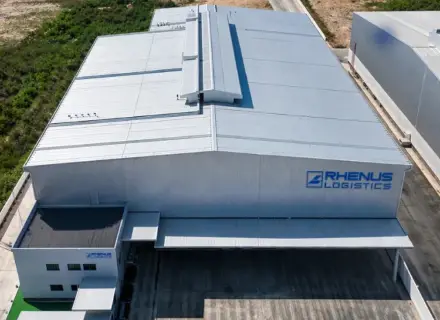

Not all cargo is created equal. A container of garments and a container of lithium batteries require entirely different handling procedures, facilities, and regulatory oversight. Getting the latter wrong can mean fires, chemical leaks, or worse. As trade in regulated and hazardous materials grows across Southeast Asia, the infrastructure to handle it safely has not always kept pace.
A new facility opened by Rhenus Group (a German logistics company headquartered in Holzwickede, near Dortmund) near Bangkok on May 11 is part of an effort to close that gap. The warehouse is located at 601 Moo 15, Bang Sao Thong Sub-District, Bang Sao Thong District, Samut Prakarn Province.
Rhenus, a global logistics company with a broad footprint across Europe and Asia (operating in 63 countries with 1000+ warehouses), has opened the specialised warehouse for dangerous goods near two of Thailand’s most strategically important trade gateways, Suvarnabhumi Airport and Laem Chabang Port.
Suvarnabhumi is one of Asia’s busiest international airports, while Laem Chabang is Thailand’s largest deep-sea port and handles the bulk of the country’s container trade.
The facility is built to handle classes 3 through 9 of dangerous goods, which, under international classification systems, covers everything from flammable liquids and toxic substances to corrosive materials and miscellaneous regulated items. The facility includes temperature-controlled storage, which is critical for certain chemicals, pharmaceuticals, and industrial compounds that degrade or become unstable outside specific conditions.
Services at the warehouse include packing, labelling, and documentation, all of which are required under IATA and ICAO regulations for the air and sea transport of hazardous materials. Incorrectly labelled or documented dangerous goods can be refused at ports, grounded at airports, or worse, cause incidents in transit.
The facility operates around the clock, offering 24/7 services to accommodate the continuous flow of international trade.
The head of Rhenus operations for the Asia-Pacific region described the facility as a move that ‘boosts supply chain resilience for high-value and regulated cargo’. That phrase captures the dual nature of much of what will pass through this warehouse. Dangerous goods are often also high-value goods, whether they are industrial chemicals, battery components for electronics, or pharmaceutical raw materials. Handling them well is not just a matter of safety; it is a business imperative.
For Thailand and the broader Southeast Asian region, the opening reflects a broader pattern of logistics infrastructure investment driven by rising manufacturing activity and growing trade links with China, Europe, and the Middle East.
Rhenus has been actively expanding its air freight operations in the region, and this Bangkok warehouse fits into that larger strategic push. By positioning a world-class dangerous goods facility at the heart of Thailand’s export infrastructure, the company is signalling confidence in Southeast Asia’s continued growth as a manufacturing and trade hub, and making a practical bet that regulated cargo volumes will keep rising.