
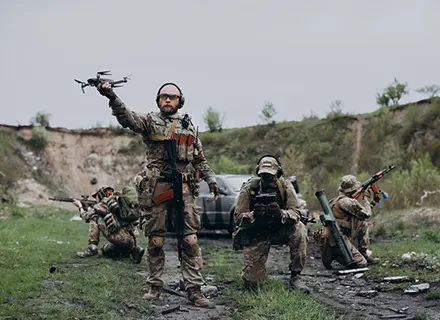

Three years ago, most European venture capitalists would not take a meeting about weapons technology. Today, defence is arguably the hottest vertical on the continent’s cap tables, and no category within it is drawing more capital, policy attention, or industrial urgency than drones.
In the space of roughly two weeks in July 2026, NATO unveiled a multi-billion dollar drone initiative, the United Kingdom committed billions of pounds to drone and counter-drone systems, Germany moved to fund 50,000 drones bound for Ukraine, and Munich-based Helsing closed a funding round that valued the company at USD 18 billion.
Taken individually, each is a notable headline. Taken together, they mark a structural shift in how Europe thinks about defence – and where it is putting its money.
From battlefield lesson to procurement line item
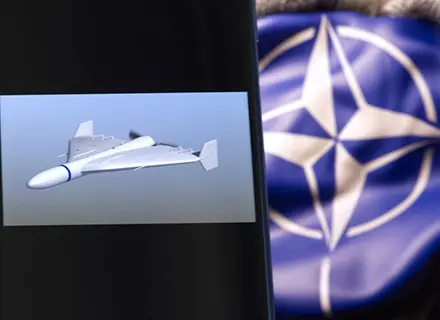
The proximate cause is straightforward: war has changed, and Europe has been watching it happen next door. Russia’s invasion of Ukraine, combined with Iran’s use of inexpensive Shahed-type drones in Middle East conflicts, has demonstrated that cheap, AI-enabled unmanned systems can extend the reach of conventional forces, gather intelligence continuously, and increasingly operate with minimal human input.
NATO Secretary General Mark Rutte has framed this shift starkly, saying the alliance must become “drone-ready,” and describing drones as a decisive factor in the character of modern warfare. Allies have now committed to investing more than $40 billion in counter-drone capabilities over five years under that initiative.
The United Kingdom’s five billion pound “drone transformation” programme, part of its “Defence Investment Plan” published in late June, follows the same logic: Cheap, attritable, software-defined systems are being treated not as a niche capability but as a core pillar of force structure.
ALSO READ | Europe’s defence boom turns tanks and drones into stock markets’ favourite trade
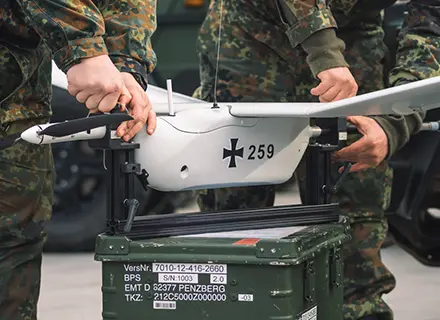 Germany’s decision to fund 50,000 drones for Ukraine – a 90-million-euro order built around operating software from Zurich-based Auterion and hardware from Ukrainian manufacturer Skyfall – illustrates how quickly procurement cycles are compressing when the underlying technology is proven in combat rather than in a lab.
Auterion CEO Lorenz Meier has pointed to something analysts increasingly echo: This is the first major conflict fought at a moment when drones were mature enough to matter at scale, and the software layer – not just the airframe – is what determines whether a drone survives contact with electronic jamming.
Auterion’s operating system is designed to keep drones locked onto a target even when a signal is being jammed, and the company is building tools to let one operator direct coordinated swarms rather than piloting aircraft individually. That is a meaningful shift for the underlying economics of the sector: Value is migrating from the physical airframe towards the code and sensor fusion that make it useful.
The money behind the shift
The scale of capital now moving into this space is difficult to overstate. Core defence spending among European NATO members has roughly doubled since 2019, and under NATO’s new 3.5% of GDP target agreed at the 2025 Hague summit, McKinsey estimates European defence outlays could approach 800 billion euro by 2030 – around 2.9% of GDP.
Public markets have already priced in much of that shift: An equally weighted index of large, listed European defence companies has returned roughly 400% since 2022, with most of that outperformance concentrated since early 2025.
Venture capital has followed. According to Dealroom data cited in industry analysis, European defence, security, and resilience startups raised roughly USD 8.7 billion in 2025 – up 55% year-over-year, and nearly four times the level of five years earlier.
 Defence now accounts for close to 10% of all European VC funding, up from under 1% before 2020, and about a third of European deep-tech funding overall. McKinsey’s own analysis found that investment in European defence-tech startups rose more than 500% between 2021 and 2024 compared with the preceding three years.Autonomous systems – drones chief among them – are the single largest draw within that pool of capital, alongside situational awareness, intelligence and reconnaissance technology, and space systems, which together absorbed roughly 44% of 2025’s defence-tech funding by some estimates.
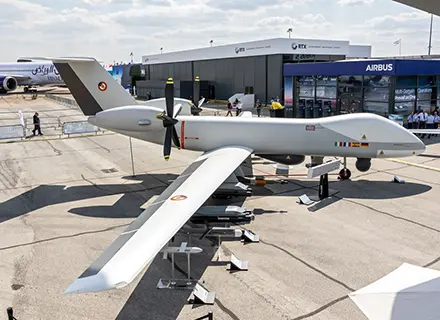
Helsing’s new valuation, reached in an oversubscribed round led by US investors Dragoneer and Lightspeed, cements it as Europe’s best-capitalised pure-play defence-tech company; peers such as Munich-based Quantum Systems and Portugal’s Tekever have also reached unicorn status on the strength of drones and reconnaissance systems that have been tested in Ukraine and are now moving into NATO procurement pipelines.
 Globally, the military drone market itself is sizable and growing, though estimates vary by methodology: Industry forecasts from firms such as MarketsandMarkets and Fortune Business Insights put the sector in the range of USD 15–USD 22 billion by 2030, while broader “drone warfare” market definitions that include counter-drone and swarm technology run considerably higher.
What most forecasts agree on is the growth driver: AI-enabled autonomy and battery-powered small systems are the fastest-growing segments, a trend that maps closely onto what has proven effective in Ukraine.
Beyond the airframe: where the real opportunity sits
Morningstar analyst Loredana Muharremi has described the direction of travel as a “layered battlefield,” in which a single platform like a tank no longer just fires shells but launches its own drones, receives live targeting data from satellites and other unmanned aircraft, and operates as one node in a networked force.
That vision has direct implications for where investors and corporate strategists are placing bets: The opportunity extends well beyond companies that physically build drones into the ecosystem that lets them operate together – secure communications, battle-management software, artificial intelligence, satellite-based sensing, and electronic warfare.
ALSO READ | Can Britain’s 298 billion pound ‘Defence Investment Plan’ keep the country safe?
That is also, notably, where much of the structural risk in Europe’s defence-tech boom sits. Despite the surge in funding, American investors still supply a large share of the capital flowing into European defence-tech – estimates from multiple analyses put the US share of late-stage rounds at roughly 40%-65%, and the United States still generates several times more venture deal volume in defence than Europe does.
 Helsing’s own funding round, while framed as a milestone for European defence sovereignty, was led by US firms even as the company remains majority European-owned. European public R&D spending on defence – around USD 40 billion between 2020 and 2024, according to comparisons cited in recent industry analysis – remains a fraction of the roughly USD 520 billion the US spent over the same period.
There are also structural bottlenecks that money alone does not solve. Europe’s defence procurement processes are frequently criticised as slow, fragmented across 27-plus national systems, and poorly matched to the iterative pace at which venture-backed startups want to build and ship hardware.
Exit paths remain narrow: With essentially no defence-tech IPOs in Europe in 2025, acquisition by an established prime contractor – the likes of Airbus, BAE Systems, Rheinmetall, Thales, or Leonardo – is, for now, the dominant route to liquidity for founders and their investors.
That is reshaping the competitive landscape into one where nimble software-and-autonomy startups increasingly partner with, rather than displace, the continent’s traditional industrial primes.
New hubs, new winners
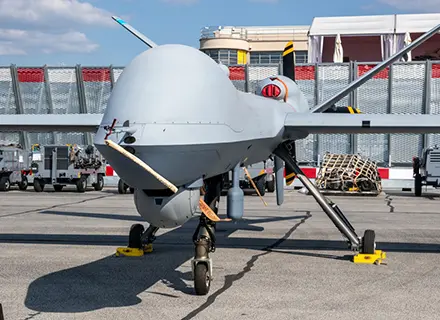 The geography of this boom is also shifting. Munich has emerged as one of the fastest-growing defence-tech clusters in Europe, drawing on the region’s automotive supply-chain expertise for precision manufacturing of drone frames and space hardware. The UK holds five of Europe’s Top 10 defence-tech funding hubs, including Oxford, London, and Cambridge, while Germany’s strength is concentrated in Munich.
Second-tier hubs in Poland and the Baltic states are producing a high volume of early-stage deals, though founders there still typically travel to London or Berlin when they need the larger checks required to build at factory scale.
Institutional structures are adapting alongside the capital. The “NATO Innovation Fund,” a vehicle backed by two dozen allied governments, has reviewed well over a thousand startup applications and selected several dozen for investment and support through its DIANA accelerator programme.
ALSO READ | European defence company Destinus tests deep-strike system Ruta Block 2
National initiatives are following a similar model: Ukraine’s Brave1 platform channels funding and battlefield feedback directly to drone makers, while a new EU pilot scheme called AGILE aims to issue smaller grants to startups solving urgent operational problems within months rather than years – a modest sum by industry standards, but one designed to fix the slow ‘middle’ of the funding pipeline between early research grants and late-stage growth capital.
The business case, in short
For corporate strategists and investors, the drone boom is best understood not as a bet on aircraft but as a bet on three converging trends: The militarisation of low-cost autonomy, the software-ification of the battlefield, and a generational reset in how much European governments are willing to spend on defence.
Companies with genuine technical depth in AI-driven autonomy, resilient communications, sensor fusion and electronic warfare are positioned to capture disproportionate value relative to those making airframes alone – a dynamic already visible in how capital has concentrated around software-centric players like Helsing and Auterion rather than pure hardware manufacturers.
The risk, for now, is less about demand – which appears firmly secured by NATO’s spending targets and by the operational lessons of Ukraine – and more about execution: Whether Europe’s procurement bureaucracies, capital markets and industrial base can absorb this money fast enough to build genuine strategic depth, rather than simply bidding up valuations on a narrow set of already-prominent companies.