
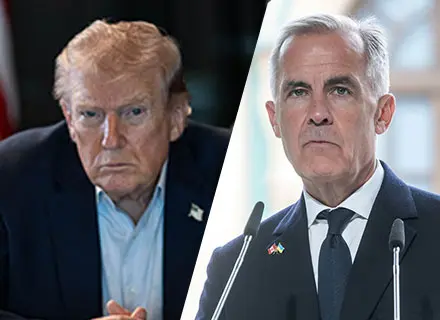

Following Donald Trump’s announcement of fresh US tariffs on Canada, American and Mexican trade negotiators have begun a third round of bilateral talks to revise the North American trade agreement.
The three-day talks, which do not include Ottawa, are also the first formal discussions on changes to the US-Mexico-Canada Agreement since the Trump administration decided not to extend the six-year-old regional trade pact on July 1.
As the USMCA faces the threat of being shut down within 10 years if the three countries don’t agree on changes, the US Chamber of Commerce has already urged Trump to keep intact the trade pact’s trilateral structure, tariff-free access and strong enforcement that underpin exchange of goods worth USD 1.6 trillion across the North America.
US Trade Representative Jamieson Greer has already laid out his administration’s number one priority: Making sure Washington, through the USMCA talks, lowers its trade deficits with Canada and Mexico, apart from reshoring more manufacturing to mainland America.
The United States’ trade deficit with Mexico, in 2025, grew by USD 28 billion, or 17%, to USD 197 billion, according to data from the US Census Bureau, which comes under the Commerce Department. The trade gap with Canada, on the other hand, fell by USD 12.9 billion, or 21%, last year to USD 48.3 billion.
“We want the outcomes to make sense. We want to have more auto manufacturing here, and we’re seeing it,” Greer told CNBC, citing moves by automakers to open new assembly capacity in the US, including Toyota’s expansion of a Texas plant to build trucks now assembled in Mexico.
General Motors will incur some USD 1.5 billion in expenses this year in part to move some vehicle production to the US. In 2025, the Detroit automaker has disclosed plans to build two Chevrolet SUV models in the world’s largest economy while shifting some of its manufacturing from Mexico from 2027 onwards.
“That’s the outcome that (Trump) wants. I think also if we can have an arrangement with Mexico, with Canada, that we are trying to emphasize Canadian, Mexican, and US content in goods traded in North America, that’s a good outcome because that helps get supply chains back here in North America,” Greer added.
During bilateral USMCA talks with Mexico in May this year, in a significant departure from the existing provisions, USTR proposed requiring that 50% of the value of North American-built vehicles originate in the United States. The demand will be a difficult one to meet for the automakers in terms of making logistical changes in their highly integrated regional supply chains.
Mexico’s new ambassador to the US, Roberto Lazzeri, said that the Latin American country was expecting to reach a new deal by the 2026-end, and that he thinks the United States and Canada are aiming for the same goal.
“Every moment that we’re losing, I think we are losing competitiveness, market share, and investment, so it’s in the best interest of all three of us to get to a position of resolution soon. Mexico shares the Trump administration’s goal of bringing more manufacturing to North America, including to the US,” said Lazzeri, a former investment banker and finance ministry official.
Talking about the new tariff warfare between the United States and Canada, the Trump administration’s new levies on nearly USD 20 billion worth of Canadian goods came as a response against Ottawa’s import taxes on American autos, steel, aluminum, and dairy, as well as provincial alcohol bans.
That move deepens a rift that has kept Canada largely sidelined in the USMCA negotiations, as Greer has said there has been little movement towards concessions.
Defending the Trump administration’s decision, Treasury Secretary Scott Bessent, during an interaction with the Fox Business Network, accused the Mark Carney government of being “highly discriminatory” on dairy products, apart from pointing toward US alcohol and beverages being moved from Canadian shelves.
“This is really just reciprocity in terms of what they’ve done to our great US companies,” Bessent told the “Mornings with Maria” program.
Mexico has found appreciations for itself, with Greer lauding the Latin American nation for its “lack of retaliation to US tariffs” and “pragmatic” approach to negotiations that include working to align Mexico’s export controls with those of the Uncle Sam, steps to protect intellectual property rights (IPR) and moving to curb the export of avocados grown on illegally deforested land.
As per Greer’s office, the talks in Mexico City will dig into technical details of the US-Mexico trade in crucial sectors like autos, steel, aluminum, agriculture, and labor.
The discussions will also focus on “economic security,” USTR’s term for raising regional trade protections to keep China and other Asian countries from using Mexico and Canada to access the lucrative American market on preferential terms.
The China point will be a contentious one, given Beijing’s growing footprint in Mexico’s car market.
As per the new distribution figures, Chinese car sales rose 30% in the first half of 2026, despite 50% tariffs imposed in January, with Chinese brands raising their market share to 17% from 14% a year earlier.