

Troubled German automaker Volkswagen estimates the total cost of job cuts and potential plant closures, part of its landmark restructuring pact, to be around 16 billion euro (USD 18.6 billion).
The European giant, while embarking on its biggest ever restructuring, citing stiff Chinese competition, US tariffs, and overcapacity, is also exploring alternatives for four German plants that will eventually run out of models during the next decade, along with a reduction of around 50,000 more positions than previously planned.
As per reports from the German magazine Der Spiegel and Reuters, phasing out production in Emden and Zwickau would cost about 1 billion euros each, while 2 billion euros each would be incurred at the Neckarsulm and Hanover plants.
About 10 billion euro would be set aside for costs related to cutting up to 60,000 jobs worldwide.
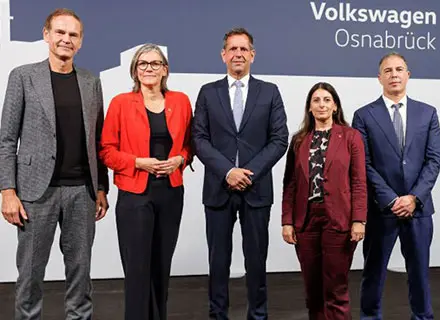
However, on September 7, the automobile giant found a ray of hope, as it signed a preliminary deal with Israel’s Aurelius Capital and Volkswagen’s home state of Lower Saxony, in which the carmaker would sell its factory in Osnabrueck that will then be repurposed for defence production under the new ownership.
According to the state’s labour officials, the move could preserve about 1,400 of the Osnabrueck site’s 1,800 jobs. The vehicle production there is due to end in 2027.
According to Volkswagen, an initial “anchor project” for Osnabrueck would be a cooperation with Israel’s Rafael Advanced Defense Systems, one of the key partners behind Israel’s Iron Dome, Arrow, and David’s Sling air and missile defence systems.
“These plans involve the potential manufacture of systems and components for air defence systems for Germany and Europe,” Volkswagen said, adding that the newfound cooperation could pave the way for further such deals.
According to reports, Volkswagen is also considering converting its Amarok pickup trucks into military vehicles in response to the increasing pace of defence spending in Europe.
When it comes to repurposing underused automotive plants for defence production, Volkswagen is not alone, as Rheinmetall and Continental are also pursuing similar initiatives.
Under the new arrangement, Aurelius would take a majority stake in the Osnabrueck site alongside Lower Saxony, whose premier Olaf Lies said the state’s engagement would be similar to its stake purchase in the Meyer Werft shipyard in 2024.
At the time, Lower Saxony spent 200 million euros (USD 232 million) for a 40% stake in the shipyard.
In its pursuits of becoming leaner, Volkswagen is also considering the sale of Ducati, the motorcycle maker owned by the Audi division.
Giving further hints about the news, Audi CEO Gernot Dollner told Bloomberg, “Within the Volkswagen Group, we are committed to disciplined, responsible portfolio management.”
“It’s part of the evaluation process that we’ll also talk about Ducati, but nothing has been decided,” he added further.
While Volkswagen is facing intense competition in China and looking to desparately scale up its 3% market share in the United States, it is also exploring a strategic partnership with Indian conglomerate JSW Group to improve competitiveness and profitability in the world’s third-largest car market.
“The partnership is aimed at expanding Volkswagen’s portfolio in India, deepening local sourcing and strengthening manufacturing,” the German giant said.
JSW Group, a steel-to-energy Indian conglomerate, entered the South Asian giant’s passenger vehicle market in 2023 through JSW MG Motor India, a joint venture with China’s SAIC Motor that sells MG-branded cars.
“The proposed collaboration will likely be structured as a two-party partnership with joint control, defined operational roles, and governance mechanisms designed to enable quicker decision-making,” Volkswagen stated further.
The duo will also explore ways to increase local sourcing, share vehicle platforms, and expand production capacity.
Volkswagen, whose market share in India stands around 2%, mainly sells vehicles through Skoda Auto in the South Asian nation.
Image Credit: Volkswagen Group