
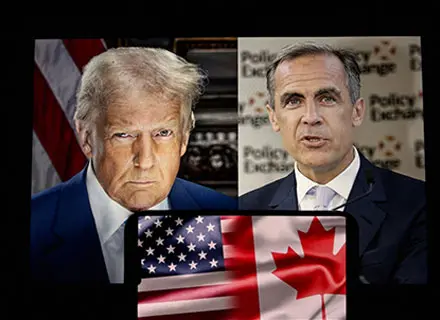

With the trade talks between the United States and Canada breaking down, resulting in both sides going into the “tariff-for-tariff” mode, the focus now shifts to Washington’s ongoing negotiations with Mexico, its other important regional trade partner, with the Latin American country’s Economy Minister Marcelo Ebrard expressing hope about his nation reaching understandings with the Donald Trump administration that are “similar in many aspects” to those being discussed between Washington and Ottawa.
Ebrard’s statement came just hours before the breakdown in negotiations between the Washington and Ottawa, a development which has now cast a shadow on the future of USMCA (United States-Mexico-Canada Agreement), that covers trade, digital commerce, intellectual property, and labor/environmental rules among the US, Mexico, and Canada.
“Mexico is pursuing its own track with the United States and would need to see the final published terms of any US-Canada arrangement before making a full assessment,” Ebrard said on Friday (August 21), just hours before Washington and Ottawa decided to move away from the negotiation table, resulting in Trump imposing 50% tariffs on a range of Canadian goods, a move that he kept previously on hold, as both sides were expecting a win-win deal on the trade front.
The failed negotiations between the US and Canada were focused on avoiding the new Section 338 tariffs and resolving a set of bilateral trade disputes, including Washington’s complaints about Ottawa’s dairy quota system, provincial restrictions on American alcohol sales, and retaliatory Canadian duties on some US-built autos and steel.
The breakdown in negotiations also coincides with the broader 2026 review of the USMCA.
In July, the Trump administration declined to extend the pact for a fresh 16-year term, triggering a process of annual reviews while the agreement remains in force through 2036 unless the three countries later agree to extend it.
US Trade Representative Jamieson Greer aimed to secure interim arrangements with both Mexico and Canada this year, while deferring more complex issues such as automotive rules of origin, labor, and environmental standards until 2027.
His talks with the Mexican government officials were described by both sides as “constructive,” pointing to progress on steel and aluminum and efforts to replace Asian imports with more North American production.
Regarding the “tariff-for-tariff” and “dollar-for-dollar” approaches taken by the United States and Canada after the failed talks, Ottawa will impose retaliatory tariffs on imports of US steel, electronics, and other products in response to Trump’s 50% pressure tactic. The new tariffs will take effect on September 8.
Trump’s new tariffs hit Canadian sectors, including wine, furniture, dairy products, cement, clothing, fishing rods, and hockey equipment, covering some USD 20 billion of Ottawa’s exports to the world’s largest economy. These duties do not exempt Canadian products under the USMCA, which has shielded most Canadian exports to the US in the past 18 months.
“Canada will match Washington’s new tariffs dollar for dollar to protect Canadian workers, farmers, families, and businesses. You’re at war when you get attacked. We got attacked,” Carney told a press conference on Saturday (August 22).
Carney, the economist-turned-PM of Canada, has emerged as one of the few global leaders to retaliate against US tariffs and has pledged to forge new trade and military alliances, despite Canada’s dependence on the United States for nearly 70% of its exports.
Taking a jab at Ottawa for missing “the opportunity to partner with the United States,” Greer said that no new talks were planned with Canada.
“We’re moving forward with measures that respond to Canadian retaliation. They’ve always had the best deal, and they still would have an even better deal, but they didn’t want that,” he told Fox News.
Canada’s retaliatory tariffs will cover US steel, dairy, appliances, agricultural equipment, pulp and paper, and electronics, along with some products that Washington previously targeted in Canada, Carney said from Ottawa’s Parliament building.
“The government will release details on its response in the coming days. We cannot accept what they have offered, and we will not give what they have asked,” remarked the former central banker, while accusing the Trump administration of halting the negotiations with its last-minute demands.
“Recently, the U.S. proposed new terms that were uneconomic, unfair, and undermined the net benefits to Canada, calling into question the reliability of any deal,” he said, adding these demands included curtailing Canada’s ability to forge new trade deals.
Canada, in the coming days, will also announce support measures for industries targeted by the Uncle Sam. The latest tariffs, as per Ottawa’s estimates, could expose some vulnerable industries such as softwood lumber and wine to severe damage, leading to job losses and business closures.
“We will be mobilizing our network of businesses in all regions and all sectors to brace for impact and make the best of a bad situation,” said Candace Laing, CEO of the Canadian Chamber of Commerce.
Ontario Premier Doug Ford, one of the most vocal opponents of Trump tariffs, supported Carney’s decision to retaliate.
“I’m glad he didn’t sign that deal because it was a terrible deal. It was a bad deal for Ontario. It was a bad deal for the auto sector, the steel sector, and the manufacturing sector,” Ford told reporters on Saturday.
One of the main sticking points was the treatment of larger vehicles, with reports suggesting that Canada wanted favorable tariff terms proposed for light-duty vehicles to extend to medium- and heavy-duty trucks. However, the United States opposed it.
Confirming the reports, Carney said the US position would have excluded Canadian-made models, including Ford’s F-350, F-450, and F-550 trucks and General Motors’ Silverado, making Canadian production less competitive.
“There were also US proposals that affected Canadian culture, language, and sovereignty,” he remarked.
While the American tariffs may end up harming Canada’s economy significantly, Carney’s tough stance against Trump may boost his popularity among the domestic audience. Polls show most Canadians oppose making any concessions to their North American neighbor.
“Canadians must stand united to defend our country against these unfair attacks on our jobs and businesses,” Pierre Poilievre, the leader of the official opposition Conservative Party, said in a statement.