
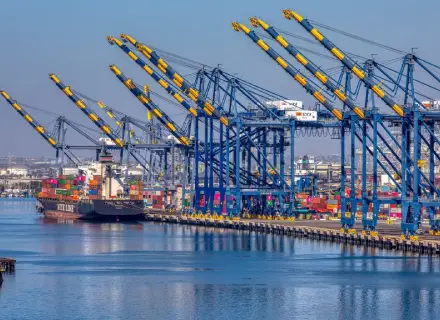

On May 9, 2026, the Port of Los Angeles opened its waters to free public boat tours, inviting residents to look at one of the most consequential stretches of ocean-facing infrastructure in the United States.
The occasion was the 100th anniversary of World Trade Week, a civic tradition that began in 1926, and has since grown into an international observance marking the role of trade in economic life.
The tours departed from the Wilmington Waterfront Promenade, near Banning’s Landing Community Centre, and the event was designed to be accessible rather than ceremonial.
To anyone outside the logistics industry, a port birthday celebration might seem like pleasant, local colour with limited relevance beyond the harbour. That reading underestimates what Los Angeles actually is in the structure of global trade.
The Port of Los Angeles, alongside its neighbour, the Port of Long Beach, forms the San Pedro Bay port complex, which handles more containerised cargo than any other port in the Western hemisphere.
Roughly 40% of all containerised imports entering the United States pass through this gateway. When labour disputes, storms, or congestion slow operations here, retailers across the country feel the impact within weeks.
The centennial comes at a moment when American ports are under more scrutiny than they have faced in decades. The COVID-19 pandemic exposed severe vulnerabilities in port infrastructure, including congestion so severe that hundreds of ships anchored offshore waiting for berths.
Since then, federal investment in port modernisation has increased, but the debates around capacity, automation, labour agreements, and environmental impact have not gone away.
The tour format was a deliberate choice. Ports are often invisible to the communities that live beside them, despite being the source of significant local employment and, frequently, significant local pollution.
By inviting residents onto the water to see terminals, cranes, and vessels at close range, the port is doing something strategically important: it is building the public goodwill that major infrastructure projects require to survive planning processes, environmental reviews, and political cycles.
The geopolitical context gives the anniversary added resonance. The United States and China are in the middle of a prolonged and escalating trade dispute. Tariffs introduced or expanded under successive administrations have reshaped trans-Pacific cargo flows.
Some importers have front-loaded shipments before new tariffs take effect; others have shifted sourcing to Vietnam, India, or Mexico. The Port of Los Angeles sits directly in the path of all these adjustments, absorbing the volume swings and routing changes that follow every new trade policy announcement from Washington or Beijing.
A port that processes nearly half of America’s containerised imports is not simply a logistics hub. It is a geopolitical instrument. Its throughput figures are read as indicators of consumer demand, trade policy impact, and the health of bilateral commercial relationships. When volumes at Los Angeles rise or fall sharply, analysts and policymakers take note.
The centennial of World Trade Week is, in that sense, a moment to take stock of what a century of organised trade advocacy has produced.
In 1926, the idea that a country’s prosperity was inseparable from its ability to move goods across borders efficiently was not universally accepted.
In 2026, with supply chains stretching across dozens of countries and billions of dollars of cargo moving through a single port every week, it is simply a fact.
The boat tours are modest. The infrastructure they show off is anything but.