
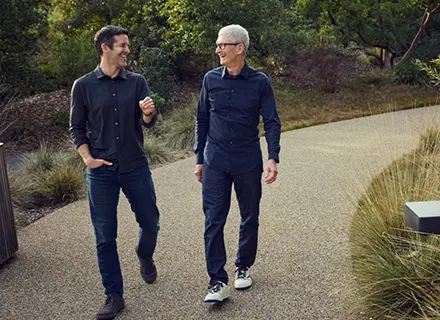

Ternus, a 25-year-old Apple veteran and the company’s hardware chief, who will be taking over the top boss’ role, inherits a business with enormous financial strength, a global installed base of more than 2.5 billion active devices, and an annual revenue of more than USD 416 billion, but one that has struggled to match the AI innovation pace set by rivals such as Google, Microsoft, and OpenAI.
After completing his 15-year record-breaking tenure as CEO, during which he led Apple to unprecedented heights, Cook will assume the role of executive chairman, allowing him to remain engaged in policymaking.
The choice of Ternus is significant. Unlike Cook, who built his reputation on operations and supply-chain management, Ternus is an engineer and product executive. He joined Apple’s product design team in 2001, became vice-president of hardware engineering in 2013, and joined the executive team in 2021.
He has overseen hardware developments across the iPhone, iPad, Mac, Apple Watch, and AirPods. His work on Apple silicon strengthened the Mac business by giving Apple greater control over processors and improving performance.
Apple’s effort to build “Apple Intelligence” has faced significant delays, especially regarding a more advanced version of Siri. As it strives to deliver AI capabilities across its devices, the company has sought outside technology, including partnerships with OpenAI and Google.
That strategy gives Apple access to powerful models but also raises questions about whether the company can develop enough proprietary AI technology to compete over the long term.
The challenge is broader than Siri. AI is changing how consumers search, create content, use software, and interact with devices. Apple faces significant challenges as its competitive edge has historically relied on its control over hardware, software, and services.
And it is also struggling with supply chain snags, especially on the chip front. To deal with the industry-wide chip shortages, the tech giant has already lifted prices across its Mac and iPad line-ups. It has also braced up for dampening sales figures in the current quarter.
Ternus must determine how AI should reshape the iPhone and wider Apple ecosystem without undermining the privacy and security principles that distinguish the company.
The timing is demanding. Apple is preparing for a major product cycle, with its September 9 launch event expected to showcase new iPhones and potentially its first foldable iPhone. It will be Ternus’s first major public product moment as CEO.
Analysts see high-end devices like the upcoming foldable iPhone eventually becoming the main driver of Apple’s higher selling prices and margin growth.
Investors will also be watching whether he can revive a perception that Apple has become more evolutionary than revolutionary. Cook leaves behind an extraordinary financial record.
Apple’s market capitalisation rose from about USD 350 billion when he became CEO to roughly USD 4 trillion, while services grew into a business generating more than USD 100 billion a year.
The company also launched successful new categories such as Apple Watch and AirPods and developed its own chip technology.
Yet Apple’s recent AI missteps have created a strategic vulnerability. The company is competing with smartphone rivals and technology companies spending tens of billions on AI infrastructure, models, and talent globally.
That could push Ternus toward a more hardware-led answer to the AI race. His engineering background may prove useful as Apple seeks to build devices in which AI is embedded rather than simply offered as a cloud service.
Future products such as foldable phones, smarter wearables, augmented-reality devices, and more powerful Macs could become important parts of that strategy.
There is also a management challenge. Ternus must preserve the operational discipline that made Cook’s Apple extraordinarily profitable while encouraging greater risk-taking and faster decision-making.
He will also have to manage relationships with suppliers, regulators, and governments at a time when Apple faces scrutiny over its App Store practices and remains dependent on a complex global manufacturing network.
For now, Ternus has the advantage of continuity. He knows Apple’s culture, products, and senior leadership from the inside and has worked under both Steve Jobs and Cook. Apple’s board has described him as the right leader to take the company into its next phase.
But continuity may not be enough. Scale, efficiency, and financial expansion defined the Cook era. The Ternus era will be judged increasingly by whether Apple can turn AI from a weakness into a new source of product leadership.
His first job, in other words, is not simply to make Apple smarter. It is to make sure the company does not fall behind while the definition of “smart” is being rewritten.
Trying to break Samsung’s monopoly
Currently, Samsung Electronics dominates the niche called the “foldable smartphone market,” with the segment touted to be the next mainstream despite its premium price tags.
Foldable phones are anticipated to be a promising opportunity for consumer electronics companies that have encountered challenges due to a significant shortage of memory and storage chips, leading to price increases and a decline in overall consumer demand.
As per the research firm IDC, there will be a 12.6% jump in foldable phone shipments in 2026, whereas conventional smartphones will see a record 16.7% export decline.
Analysts expect Apple to launch a foldable iPhone with a screen similar in size to an iPad mini. Earlier in 2026, Samsung unveiled a new passport-sized foldable phone as the South Korean tech giant seeks to consolidate its industry foothold.
Apple is expected to ship more than 17 million foldable iPhones by 2027, IDC predicted.
In 2025, Apple unveiled a slimmer iPhone Air and loaded its iPhone 17 base models with several better features. The iPhone 17 line-up helped drive a strong upgrade cycle among consumers.